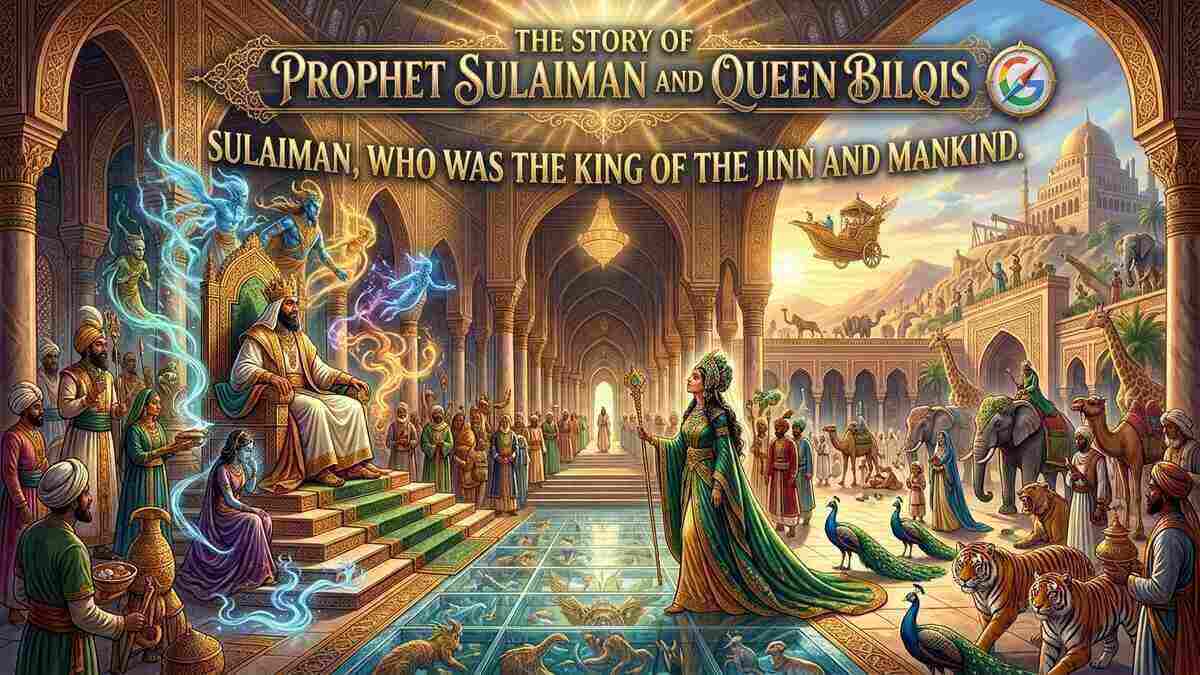
A small bird flies back to a king with news, and a powerful queen’s kingdom is never the same. That’s the heart of the story of Prophet Sulaiman and Queen Bilqis, told in Surah An-Naml. You’ll see how the Quran tells it, step by step, plus the lessons about power, humility and honest faith.
What Is the Story of Prophet Sulaiman and Queen Bilqis?
The story of Prophet Sulaiman and Queen Bilqis is the Quranic account of a prophet-king who sent a letter to the ruler of Saba’ (Sheba), a queen who worshipped the sun, and how she examined his message, tested him, and finally submitted to Allah, the Lord of the worlds.
It appears in Surah An-Naml (27:20–44). Those twenty-five verses carry a full arc: a missing bird, a letter, a gift, a throne moved in a blink, and a floor that looked like water.
Who Was Prophet Sulaiman (Solomon) in Islam?
Sulaiman was a prophet and a king, the son of Prophet Dawud (David), and he inherited his father’s knowledge and rule (27:16). Allah gave him something no other ruler had: command over the jinn, the wind and the birds, and the ability to understand the speech of animals (27:16–17).
That last gift shows up in the verses just before this story. Sulaiman’s army passes a valley of ants, and one ant warns the others to get inside. He smiles at her words and prays for the strength to be thankful (27:18–19). A man with an army that size stops to listen to an ant. Keep that image in mind.
Who Was Queen Bilqis, the Queen of Saba’?
The Quran never names her. It calls her “a woman” ruling the people of Saba’ (27:23). The name Bilqis comes from the tradition of scholars and commentators, and it’s the name most Muslims know her by.
What the Quran does say is striking. She had “everything” she needed and a magnificent throne (27:23). She and her people bowed to the sun instead of Allah (27:24). Saba’ is traditionally linked to Yemen, with Marib as its famous city. Nothing in the Quran contradicts that, but the Quran doesn’t pin it to a map.
The Story of Prophet Sulaiman and Bilqis in the Quran, Step by Step
The story of Prophet Sulaiman and Bilqis in the Quran moves fast. This table lays out the order of events:
| Event | Verses | What happens |
|---|---|---|
| The hoopoe is missing | 27:20–21 | Sulaiman notices the bird is absent and threatens a firm reckoning unless it has a good excuse |
| The report from Saba’ | 27:22–26 | The hoopoe returns with news of a queen and a sun-worshipping people |
| The letter | 27:27–31 | Sulaiman sends a message calling her to submit to Allah |
| Her consultation | 27:32–35 | Bilqis asks her chiefs for advice and decides to send a gift |
| The gift refused | 27:36–37 | Sulaiman rejects it and warns of a force they can’t face |
| The throne | 27:38–41 | Her throne is brought before she arrives |
| The glass palace | 27:42–44 | She enters, is shaken, and submits to Allah |
The hoopoe and the news from Saba’
Sulaiman inspected his birds and couldn’t find the hoopoe. He threatened to punish it unless it brought clear proof for its absence (27:20–21). The bird returned and said it had learned something Sulaiman hadn’t (27:22). It reported a woman who ruled a people, and who along with them prostrated to the sun (27:23–24).
Sulaiman didn’t react in anger. He said he’d see whether the bird was truthful (27:27). Good leaders check first.
The letter that started everything
Sulaiman sent the hoopoe with a letter. Bilqis later told her chiefs that “an honorable letter” had been delivered to her (27:29). It began with the name of Allah, the Most Gracious, the Most Merciful. It asked her not to be arrogant toward him, and to come in submission (27:30–31). It was short and direct.
How Bilqis responded: consultation, then a gift
Her reaction tells you a lot about her. She didn’t shout or decide alone. She told her council she wouldn’t settle any matter without them (27:32). They answered that they were strong and fierce, but the decision was hers (27:33). She weighed it carefully, saying kings who conquer a city ruin it (27:34), and decided to send a gift and wait for the reply (27:35).
Sulaiman refused the present. He said what Allah had given him was better than what they were offering, and that he would come with forces they couldn’t resist if they didn’t come willingly (27:36–37).
The throne moved in a blink
Before Bilqis arrived, Sulaiman asked which of his people could bring her throne to him. A strong one among the jinn offered to bring it before he rose from his seat. Another, someone with knowledge of the Book, said he’d bring it before Sulaiman’s glance returned to him (27:39–40). It was done instantly.
Sulaiman’s reaction is the real lesson. He said this was from his Lord’s favor, a test of whether he’d be grateful or ungrateful (27:40). Then he had the throne altered so he could see whether she’d recognize it (27:41). When she came, he asked, “Is your throne like this?” She said it seemed to be it (27:42). Her answer was careful, neither a yes nor a no.
The glass palace and Bilqis’s submission
Bilqis was told to enter the palace. She saw what looked like a pool and lifted her garment to cross it. Sulaiman told her it was a palace paved with smooth glass (27:44). That small moment broke her certainty. Then she said, “My Lord, I have wronged myself, and I submit with Sulaiman to Allah, Lord of the worlds” (27:44).
She didn’t submit to Sulaiman. She submitted with him, to Allah. That distinction matters.
What Can We Learn from the Story of Prophet Sulaiman and Queen Bilqis?
This isn’t a fairytale about a king impressing a queen. It’s a story about how people come to faith, and how power should be handled. These lessons stand out:
- Power is a test. Sulaiman had a throne moved in a blink and still said it was a trial of gratitude.
- Listen to the small voice. A bird carried the news that changed a kingdom. He took it seriously and verified it.
- Consult before you decide. Bilqis’s council shows that wise rulers gather advice.
- Wealth doesn’t buy the truth. Sulaiman refused her gift because his message wasn’t for sale.
- Changing your mind takes courage. Bilqis admitted she’d wronged herself. That’s the hardest sentence to say.
Notice how different the two characters are, and how both end up in the same place. One holds the greatest worldly power and stays grateful. The other holds a throne and a kingdom and still stays open to truth. Neither lets position block the way to Allah. That’s a standard worth measuring ourselves against, whatever our own job or status looks like.
Frequently Asked Questions
Is Queen Bilqis mentioned by name in the Quran?
No. The Quran refers to her only as a woman ruling Saba’ (27:23). The name Bilqis comes from commentators and later tradition.
Where is the story of Prophet Sulaiman and Bilqis in the Quran?
The main account is in Surah An-Naml, verses 20 to 44. Sulaiman’s other gifts, such as control of the wind and the jinn, appear in Surah Al-Anbiya (21:78–82) and Surah Saba (34:12–14).
Did Queen Bilqis accept Islam?
Yes. According to the Quran, she said she submitted, with Sulaiman, to Allah, Lord of the worlds (27:44).
Was the Queen of Sheba in the Bible the same person?
The outlines overlap: a queen from Sheba visits Solomon. The Quran’s version centers on belief in one God and gives no romantic storyline. Beyond the Quran, details differ between sources.
What does the hoopoe teach us?
The hoopoe shows that knowledge and sincerity don’t depend on size or rank. Sulaiman’s response, to verify rather than punish or dismiss, shows how a leader should treat information.
Conclusion: Read the Story of Prophet Sulaiman and Queen Bilqis Today
The story of Prophet Sulaiman and Queen Bilqis ends not with conquest but with a quiet prayer. A queen who had everything admits she was wrong and turns to Allah, while a king with unmatched power thanks Him for it.
Tonight, read Surah An-Naml 27:15–44 slowly with a translation you trust. Ask yourself which character you relate to most: the thoughtful hoopoe, the humble king, or the queen willing to change course. Then share this post with someone who’d enjoy the account.
For fuller understanding of any verse, consult a trusted tafsir or a qualified scholar.

2 thoughts on “Story of Prophet Sulaiman and Queen Bilqis in the Quran”