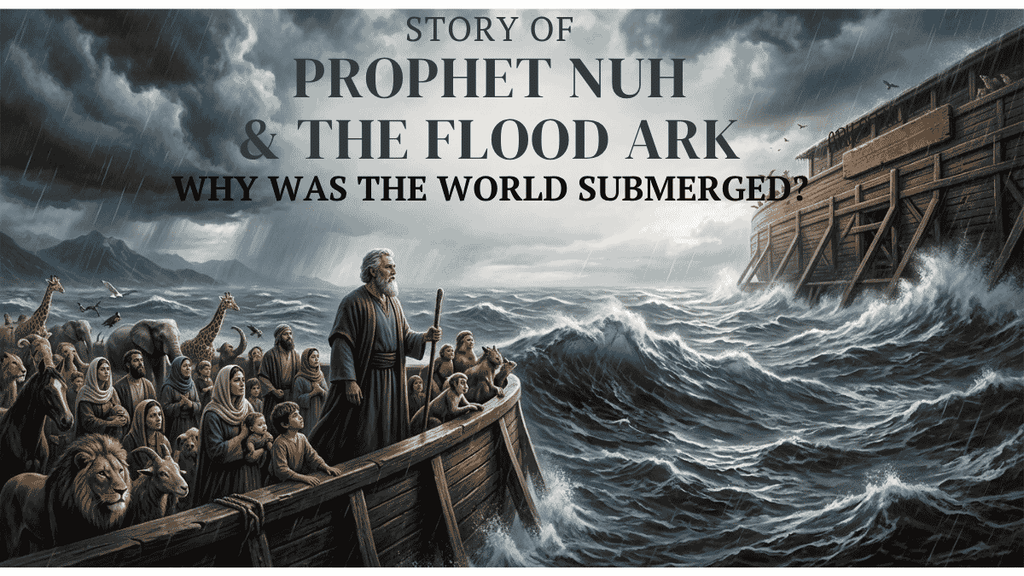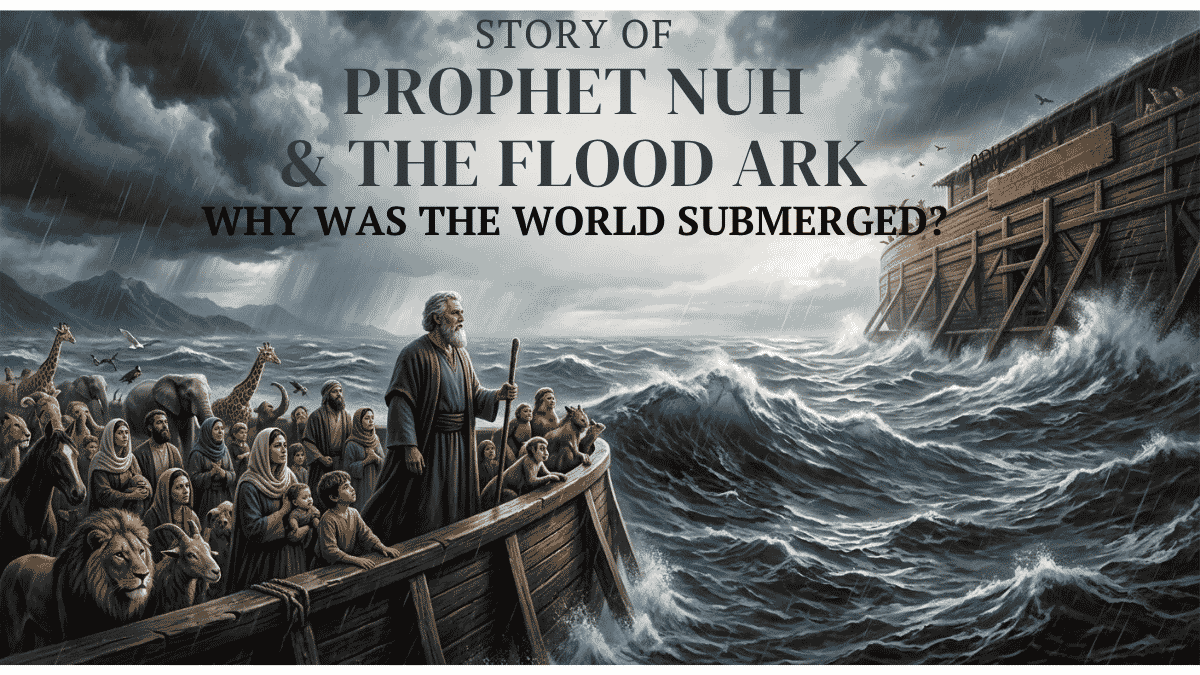
Nine hundred and fifty years is a long time to be told no. That’s how long Prophet Nuh (Noah, peace be upon him) called his people to worship Allah alone, and the story of Prophet Nuh and flood ark is what came of it. Below you’ll find the Quran’s own account, where each part appears, and the lessons that make it worth rereading.
What Is the Story of Prophet Nuh and Flood Ark?
The story of Prophet Nuh and flood ark is the Quranic account of a messenger who preached the oneness of Allah for 950 years, was rejected by most of his people, built an ark by divine command, and was saved along with the believers while a great flood destroyed those who denied him.
That’s the short version: warning, rejection, ark, flood, rescue. The longer version is where the lessons live.
Who Was Prophet Nuh (Noah) in Islam?
Nuh was one of the great messengers of Allah, sent to a community that had drifted into idol worship. Muslims count him among the five Ulul-Azm, the messengers of firm resolve, alongside Ibrahim, Musa, Isa and Muhammad (peace be upon them all).
The Quran calls him a grateful servant (17:3) and gives him an entire surah, Surah Nuh, the 71st chapter. Few prophets get that.
Where Is the Story of Prophet Nuh in the Quran?
The story of Prophet Nuh in the Quran isn’t told once, start to finish. It’s scattered across many surahs, and each telling highlights a different piece. This table shows where to look:
| Surah | Verses | What it covers |
|---|---|---|
| Al-A’raf (7) | 59–64 | His first call and his people’s rejection |
| Hud (11) | 25–49 | The fullest account: the ark, the flood, his son |
| Al-Mu’minun (23) | 23–30 | The warning, the ark and his prayer of thanks |
| Ash-Shu’ara (26) | 105–122 | His message and the people’s threats |
| Al-Ankabut (29) | 14–15 | The 950 years |
| Al-Qamar (54) | 9–15 | The flood as a lasting sign |
| Nuh (71) | 1–28 | His long appeal and his final prayer |
If you only have time for one passage, read Surah Hud 11:25–49. If you want to understand his heart, read Surah Nuh.
What Did Prophet Nuh Call His People To?
A message of one God
His message was simple and never changed: worship Allah alone, fear Him, and obey the messenger. The people’s idols were named in Surah Nuh (71:23): Wadd, Suwa’, Yaghuth, Ya’uq and Nasr. A narration in Sahih al-Bukhari from Ibn Abbas says these began as names of righteous people whose memory was later turned into worship. It’s a slow slide, not a sudden one.
Day and night, openly and in secret
Surah Nuh records his own report to Allah. He called them by night and by day, in public and in private (71:5–9). Every time he invited them, they pressed their fingers in their ears and covered themselves with their garments. He also offered them something concrete: ask forgiveness, and Allah would send rain, wealth, children and gardens (71:10–12).
Why the leaders mocked him
The chiefs said he was only a man like them, and that his followers were just the lowest of the people (11:27). Notice the pattern. The wealthy dismissed the message because of who was listening to it. Nuh refused to drive the believers away (11:29).
How Was Nuh’s Ark Built and How Big Was It?
Allah commanded Nuh to build the ark under His watch and by His revelation (11:37). Surah Al-Qamar describes it as a vessel of planks and nails (54:13). That’s about as much construction detail as the Quran gives.
Here’s a point worth being straight about: the Quran doesn’t state the ark’s dimensions, the type of wood, or the number of decks. The Book of Genesis does give measurements, but those figures come from the Bible, not the Quran. If you see an exact size attributed to the Islamic account, check where it came from.
What the Quran does record is the mockery. Each time his people’s leaders passed by while he built, they laughed at him. His reply was calm: if you mock us now, we’ll see who is mocking whom (11:38).
What Happened When the Flood Came?
The sign came when “the oven gushed forth” (11:40, 23:27). Scholars have understood this as the moment the waters began to surge from the earth. Nuh was told to load pairs of every kind, his family (except those against whom the word had already gone out), and the believers, who were few.
As the ark moved, Nuh said that its sailing and its anchoring were in the name of Allah (11:41). The waves rose like mountains (11:42).
The son who stayed behind
This is the most painful moment in the story. Nuh called to his son, who stood apart, and begged him to board. The son answered that he’d climb a mountain and be safe. Nuh told him there was no protection that day from Allah’s decree, except for those He had mercy on. Then a wave came between them, and the son was among the drowned (11:42–43).
The Quran also mentions Nuh’s wife, who, like Lut’s wife, betrayed her faith despite living with a righteous prophet (66:10).
Where did the ark come to rest?
When the command came for the earth to swallow its water and the sky to hold back its rain, the flood subsided, the matter was settled, and the ark rested on al-Judi (11:44). Tradition places al-Judi in the Cizre region of southeastern Turkey. Nobody has confirmed the exact spot, and the Quran doesn’t pin it to a map.
What Lessons Does the Story of Prophet Nuh Teach Us?
The story of Prophet Nuh in the Quran isn’t there as ancient history for its own sake. It’s there to be used. These are the lessons readers take from it most often:
- Patience has no deadline. Nuh didn’t quit after ten years, or a hundred. He kept going for centuries.
- Truth isn’t decided by headcount. He had a handful of followers. They were the ones in the ark.
- Faith, not family, is what saves. His son and his wife are the hardest proof of this.
- Seeking forgiveness opens doors. His promise in Surah Nuh ties istighfar to relief and provision.
- Do your part, then trust Allah. He built the ark, then relied on Allah for the rest.
None of this stays in the past. You may never face a flood, but you will face moments when you’re outnumbered, mocked or ignored for doing what’s right. Nuh’s example gives a practical pattern: keep calling gently, keep your own conduct clean, and don’t measure success by how many people clap. Read Surah Nuh again after a hard week and you’ll notice how honest his prayer is. He doesn’t hide his exhaustion from Allah, and that honesty is part of his strength.
Frequently Asked Questions About the Story of Prophet Nuh
How long did Prophet Nuh preach to his people?
Prophet Nuh preached for 950 years. Surah Al-Ankabut (29:14) says he stayed among his people for a thousand years less fifty before the flood took them.
How many people were on Nuh’s ark?
The Quran says only a few believed with him (11:40) and doesn’t give a number. Reports with specific counts come from outside the Quran and differ from one another.
Was the flood in the Quran global or local?
Scholars disagree. Some read Nuh’s prayer that no dwelling of the disbelievers be left on earth (71:26) as a worldwide event. Others understand it as limited to his people’s land. Both views are found in classical commentary.
Was Nuh’s son a believer?
No. He refused to board the ark and was drowned (11:42–43). Allah told Nuh that this son was not of his family in the sense of faith, which reminds us that belief, not blood, defines who is saved.
Is the Quran’s flood story the same as the Bible’s?
The outline is similar: a righteous man, an ark, a flood, a rescue. The Quran puts its weight on the message and the moral choice, gives no dimensions, and includes Nuh’s son’s refusal as a central scene.
Conclusion: Read the Story of Prophet Nuh and Flood Ark for Yourself
The story of Prophet Nuh and flood ark is about endurance as much as judgment. A man warned his people for 950 years, built a ship while they laughed, and trusted Allah when his own son turned away.
Tonight, open Surah Nuh and read it slowly with a translation you trust. Then read Surah Hud 11:25–49. Ask yourself which part of his struggle feels familiar, and share this article with someone who’d like to read the account too.
For fuller understanding of any verse, consult a trusted tafsir or a qualified scholar.