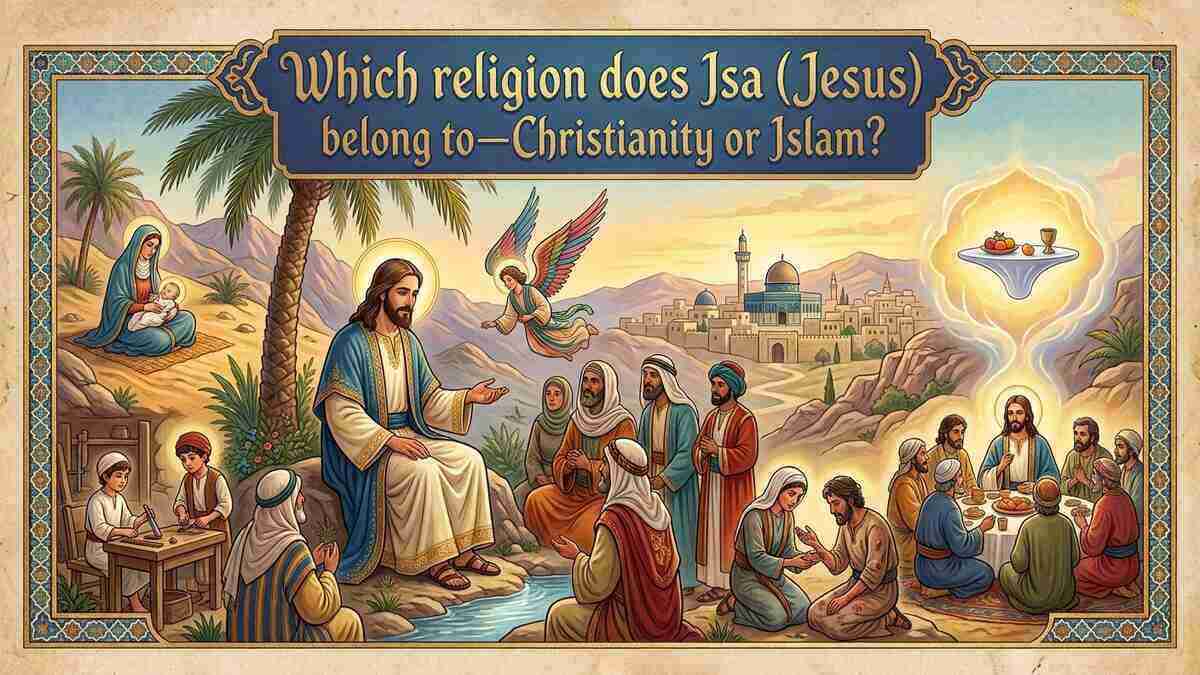
Muslims love Jesus. That surprises many people, but Isa (peace be upon him) is one of the most honored messengers in the Quran, and his mother has an entire chapter named after her. The story of Prophet Isa Jesus in Islam covers his miraculous birth, his miracles, his mission and his return. Here’s how the Quran tells it, in plain terms.
What Is the Story of Prophet Isa Jesus in Islam?
The story of Prophet Isa Jesus in Islam is the Quranic account of a mighty messenger of Allah, born to the virgin Maryam (Mary) by Allah’s command, who performed miracles by Allah’s permission, called the Children of Israel to worship Allah alone, and was raised up to Allah rather than killed. Muslims also believe he will return before the end of time.
Notice what’s central: Isa is a human prophet and servant of Allah, not God and not the son of God. That one point shapes everything else below.
Who Was Maryam, the Mother of Prophet Isa?
Maryam is the only woman named in the Quran, and Surah Maryam (chapter 19) carries her name. Her mother, the wife of Imran, vowed her unborn child to Allah’s service (3:35). Maryam grew up devout, under the care of the prophet Zakariya (3:37). The Quran calls her chosen and purified above the women of the worlds (3:42).
That’s the person Allah chose for the miracle that followed.
How Was Prophet Isa Born According to the Quran?
The birth is told in Surah Al-Imran (3:42–47) and Surah Maryam (19:16–34). Both give details.
The angel’s announcement
Allah sent Jibril (Gabriel) to Maryam in the form of a man while she was alone. She said she sought refuge in the Most Merciful from him, if she was a God-fearing person (19:16–18). He told her he was only a messenger of her Lord, sent to give her a pure son (19:19). She asked how that could be when no man had touched her (19:20). The answer was that it’s easy for Allah, and that the child would be a sign for people and a mercy (19:21).
The Quran gives him a name and title: the Messiah, Isa son of Maryam, honored in this world and the next (3:45). It also compares his creation to Adam’s: Allah created Adam from dust and said “Be,” and he was (3:59). Both came into being without a father.
Birth beneath the palm tree
When labor came, Maryam withdrew to a distant place, and the pains brought her to the trunk of a palm tree. She cried out that she wished she had died before this (19:22–23). A voice told her not to grieve, that a stream flowed beneath her, and that she should shake the palm trunk so ripe dates would fall (19:24–25). She was told to eat, drink, and if anyone asked, to say she had vowed a fast of silence (19:26).
It’s one of the most human scenes in the Quran. Fear, exhaustion, and then care.
The baby who spoke
When she returned carrying the child, her people accused her harshly. She didn’t argue. She pointed to the baby (19:27–29). Then Isa spoke from the cradle: “Indeed, I am the servant of Allah. He has given me the Scripture and made me a prophet” (19:30). He added that Allah had made him blessed wherever he was and commanded him to pray and give charity as long as he lived (19:31).
That was his first miracle, and it protected his mother’s honor.
What Miracles Did Prophet Isa Perform in the Quran?
Every miracle, the Quran stresses, happened “by Allah’s permission.” Isa never claimed power of his own. This table lists the ones named in the Quran:
| Miracle | Verse | Note |
|---|---|---|
| Speaking as a baby | 19:29–33 | Defended Maryam and declared his servanthood |
| Making a clay bird that lived | 3:49, 5:110 | He breathed into it and it became a bird, by Allah’s permission |
| Healing the blind and the leper | 3:49, 5:110 | Done openly before his people |
| Raising the dead | 3:49, 5:110 | Again, by Allah’s permission |
| Telling what people ate and stored | 3:49 | Knowledge granted by Allah |
| The table spread from heaven | 5:112–115 | Requested by his disciples as a sign |
The fifth chapter of the Quran, Al-Ma’idah, is named after that last event, the table.
What Did Prophet Isa Teach?
A message of one God
His call matched every prophet’s before him: worship Allah, my Lord and your Lord (3:51). He came confirming the Torah and was given the Injil, the Gospel, with guidance and light (5:46). He also made lawful some things that had been forbidden to the Children of Israel (3:50).
His disciples and the good news of Ahmad
Most of his people turned away, but a group said they were Allah’s helpers and asked him to witness that they submitted (3:52). The Quran calls them the Hawariyyun, the disciples. Isa also gave glad tidings of a messenger coming after him whose name would be Ahmad (61:6). Muslims understand this as Prophet Muhammad (peace be upon him).
What Does Islam Say About the Crucifixion and the Return of Isa?
This is where Islam and Christianity part ways most sharply, and it’s worth stating carefully.
The crucifixion
The Quran says they neither killed nor crucified him; it only appeared that way to them (4:157). Allah raised him up to Himself (4:158). Muslims understand this to mean Isa was taken up alive, not executed.
The return before the Last Day
Many scholars read the Quran (43:61) as pointing to Isa as a sign of the Hour. Authentic hadith in Sahih al-Bukhari and Sahih Muslim describe his descent before the end of time. When he returns, he’ll follow the final message and not bring a new religion.
What the Quran says about his status
The Quran addresses this directly. The Messiah, son of Maryam, was only a messenger, and Allah is one God (4:171). On the Day of Judgment, Isa himself will be asked whether he told people to take him and his mother as gods, and he will deny it, saying he told them only what Allah commanded (5:116–117).
How Is the Islamic View of Isa Different from Christianity?
Here’s a quick side-by-side of the main points:
- His nature: Islam says a human prophet. Christianity generally says the Son of God.
- His birth: Both accept the virgin birth.
- His miracles: Both affirm them; Islam adds “by Allah’s permission” every time.
- The cross: Islam says he was raised, not killed. Christianity centers on the crucifixion.
- His return: Both expect his return, with different roles.
Differences in belief deserve honest, respectful discussion. The story of Prophet Isa in Islam doesn’t ask anyone to lessen their love for Jesus. It asks them to see him as Muslims do.
If you’re reading this as a non-Muslim, you’ll find more common ground than you expected: reverence for Maryam, belief in the miracles, and love for Isa’s character. If you’re a Muslim, the story is a reminder to honor him properly, as a servant and messenger, neither more nor less than Allah made him.
Frequently Asked Questions
Is Isa mentioned in the Quran?
Yes. Isa, the Messiah, son of Maryam, is mentioned in many chapters, including Al-Imran, An-Nisa, Al-Ma’idah and Maryam.
Do Muslims believe in Jesus?
Yes. Believing in Isa as a true messenger of Allah is part of Islamic faith. Muslims don’t believe he is God or the son of God.
Did Isa die on the cross according to Islam?
No. The Quran says he wasn’t killed or crucified, and that Allah raised him up (4:157–158).
Will Isa return, according to Islam?
Yes. Authentic hadith describe his descent before the Last Day, and many scholars link this to Surah Az-Zukhruf 43:61.
How is the story of Prophet Isa in Islam different from the Bible?
Both tell of a virgin birth and miracles. The Quran emphasizes his servanthood and denies the crucifixion and divinity.
Conclusion: Read the Story of Prophet Isa Jesus in Islam for Yourself
The story of Prophet Isa Jesus in Islam is one of honor, mercy and honesty. A baby speaks to defend his mother, a messenger heals by Allah’s permission, and his final word to his people is that he told them only to worship Allah.
Open Surah Maryam tonight and read verses 16 to 36 with a translation you trust. Then read Surah Al-Imran 3:42–55. Share this post with someone who’s curious how Muslims see Jesus, and keep the conversation kind.
For fuller understanding of any verse, consult a trusted tafsir or a qualified scholar. You can read…….
