A baby floats down the Nile in a basket, and the most powerful man in Egypt ends up raising him in his own palace. That one irony drives the story of Prophet Musa and Pharaoh, the most detailed prophet narrative in the Quran.
Musa (Moses, peace be upon him) is mentioned by name more often than any other prophet. This guide walks through his life in order, shows where each part appears in the Quran, and ends with lessons that still apply.
Who Was Pharaoh in the Story of Prophet Musa?
The Quran never gives Pharaoh’s personal name. It uses the title “Fir’awn” for a ruler who lorded it over Egypt, split his people into groups, and weakened the Children of Israel (Surah Al-Qasas, 28:4). Historians debate which king he was. The Quran doesn’t settle that, and the message doesn’t depend on it.
What the text does give is his character. He was proud, paranoid, and convinced he was above accountability. In Surah An-Nazi’at (79:24) he claims, “I am your lord, most high.”
How Was Musa Saved as a Baby?
Pharaoh had been killing the newborn sons of the Children of Israel. Allah inspired Musa’s mother to nurse her baby and, when she feared for him, to place him in the river and not to grieve (28:7).
Raised in the house of the man hunting him
The basket reached Pharaoh’s household. His wife asked that the child be spared and kept as a comfort to them (28:9). Meanwhile Musa’s sister followed the basket at a distance, and Allah arranged for the baby to refuse other nurses, so he was brought back to his own mother (28:11-13).
Read that again. The family Pharaoh was trying to destroy paid no ransom and won no battle. Allah simply returned the child, under Pharaoh’s own roof, with a salary.
Why Did Musa Leave Egypt?
As a young man, Musa saw two men fighting, one from his own people and one an Egyptian. He struck the Egyptian to stop him, and the man died. Musa immediately regretted it and asked Allah for forgiveness (28:15-16). When he learned that officials were discussing his arrest, he left the city in fear (28:20-21).
Madyan: ten years of ordinary life
He reached Madyan, helped two women water their flock without asking for anything, and prayed, “My Lord, I am in need of whatever good You send down to me” (28:24). He ended up working for their father and marrying one of his daughters. The agreed term was eight or ten years (28:27).
This stretch is easy to skip, but it matters. The man who would confront an empire first spent a decade as a shepherd and a servant.
The Burning Bush and the Call at Mount Tur
On the journey back, Musa saw a fire and went toward it hoping for warmth or direction. There he was addressed directly: “Indeed, I am your Lord” (20:12). He was given two signs: his staff turned into a moving serpent, and his hand came out shining white (20:17-22).
Musa asked for help, and Allah granted his brother Harun as a partner (20:29-36). Then came the instruction for how to speak to Pharaoh: gently, “perhaps he may be reminded or fear Allah” (20:44).
The Showdown: Musa Confronts Pharaoh
Pharaoh dismissed Musa as a magician and a troublemaker. He proposed a public contest on a festival day, and his best magicians gathered.
The magicians who changed sides
They threw their ropes and staffs, and the crowd saw them as slithering snakes. Musa threw his staff, and it swallowed up what they had faked (20:69-70). The magicians knew their craft better than anyone, so they recognized this wasn’t a trick. They fell in prostration and declared belief.
Pharaoh threatened them with mutilation and crucifixion. They answered that they would not choose him over the clear proof they had seen (20:71-73). Of everyone in the story, they pay the highest immediate price for faith and show the least fear.
The signs sent against Pharaoh’s court
The Quran says Musa was given nine clear signs (17:101). Several are named in Surah Al-A’raf (7:133):
| Sign | Reference |
|---|---|
| The staff turning into a serpent | 7:107 |
| The shining hand | 7:108 |
| Years of drought and shortage | 7:130 |
| Flood | 7:133 |
| Locusts | 7:133 |
| Lice | 7:133 |
| Frogs | 7:133 |
| Blood | 7:133 |
Each time, Pharaoh’s people begged for relief, promised to believe, then went back on their word.
The Exodus and the Parting of the Sea
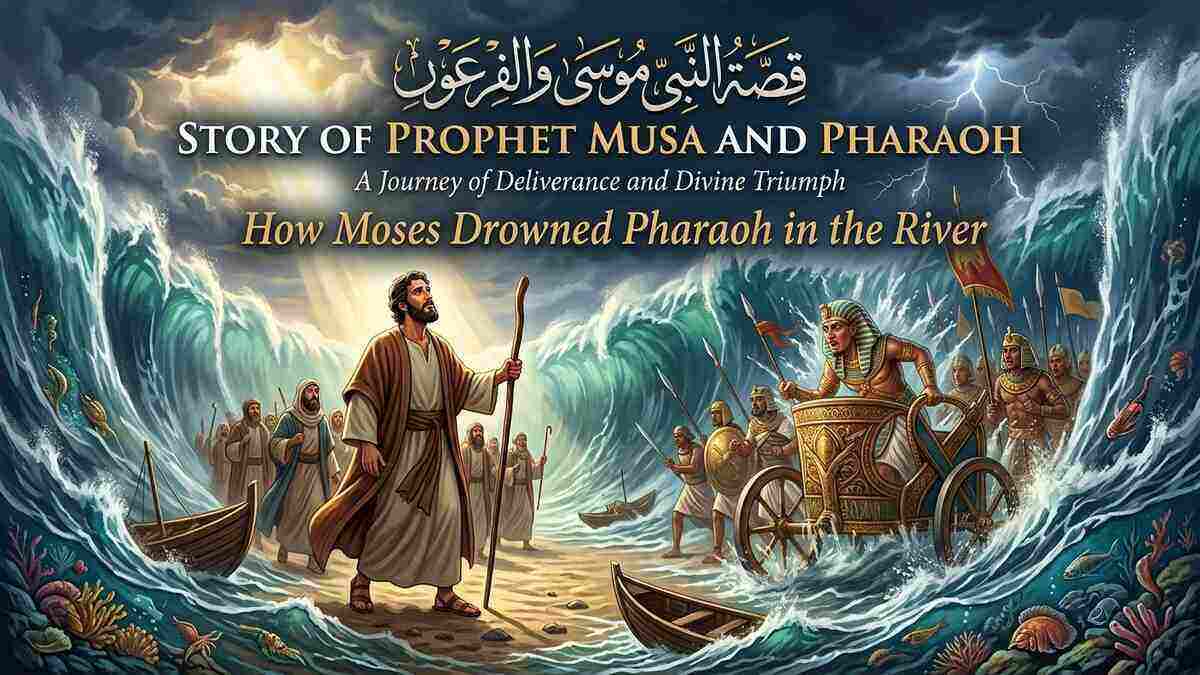
Allah commanded Musa to leave at night with the believers (26:52). Pharaoh followed with his army. At the shore, the Children of Israel panicked: “We are going to be overtaken!” Musa replied, “No. My Lord is with me, and He will guide me” (26:61-62).
Allah told him to strike the sea with his staff, and it split into great mountain-like walls (26:63). The believers crossed. Pharaoh’s troops followed and the water closed over them.
Pharaoh’s last-minute declaration
As he drowned, Pharaoh said he believed in the God of the Children of Israel. The answer was that it came too late (10:90-91). Allah then said He would preserve his body as a sign for later generations (10:92). The Quran doesn’t identify which preserved body this refers to, so it’s wise not to claim a specific mummy.
5 Lessons from the Story of Prophet Musa and Pharaoh
- Allah’s plan can run through your enemy’s house. The child Pharaoh feared was raised by Pharaoh.
- Calling someone to the truth starts with kindness. Even Pharaoh was to be spoken to gently.
- Regret and repentance are part of a prophet’s life. Musa asked forgiveness the moment he realized his mistake.
- Power doesn’t stop belief. The magicians chose faith while Pharaoh held the whip.
- Repentance has a deadline. Waiting until the last second didn’t work for Pharaoh.
Frequently Asked Questions
What is the story of Prophet Musa and Pharaoh in short?
Prophet Musa was born when Pharaoh was killing Israelite baby boys. Allah saved him and had him raised in Pharaoh’s palace. Years later, Allah sent him back to call Pharaoh to worship Him. Pharaoh refused, chased the Children of Israel, and drowned in the sea.
Who was the Pharaoh in the time of Prophet Musa?
The Quran doesn’t name him. It uses only the title “Fir’awn.” Historians have proposed several kings, but there’s no agreed answer.
How many signs did Allah give Prophet Musa?
The Quran mentions nine clear signs (17:101), including the staff, the shining hand, and a series of punishments such as locusts, frogs, and blood.
Where is the story of Musa and Pharaoh in the Quran?
It appears in many chapters. Key passages are Surah Al-Qasas (28), Surah Ta-Ha (20), Surah Al-A’raf (7:103-137), Surah Ash-Shu’ara (26:10-68), and Surah Yunus (10:75-92).
Did Pharaoh accept Islam before he died?
He declared belief while drowning, but the Quran says it was not accepted because it came at the point of death (10:90-91).
Conclusion
The story of Prophet Musa and Pharaoh is a long case study in two ways of using power: one built on pride, the other on trust in Allah. Pharaoh had an army and lost everything. Musa had a staff and a promise, and that was enough.
Today, pick one passage to study properly. Open Surah Ta-Ha (20:9-79) in a translation you trust, read it slowly, and then pass this article on to someone who is curious about the prophets.

1 thought on “Story of Prophet Musa and Pharaoh: From the River to the Red Sea”