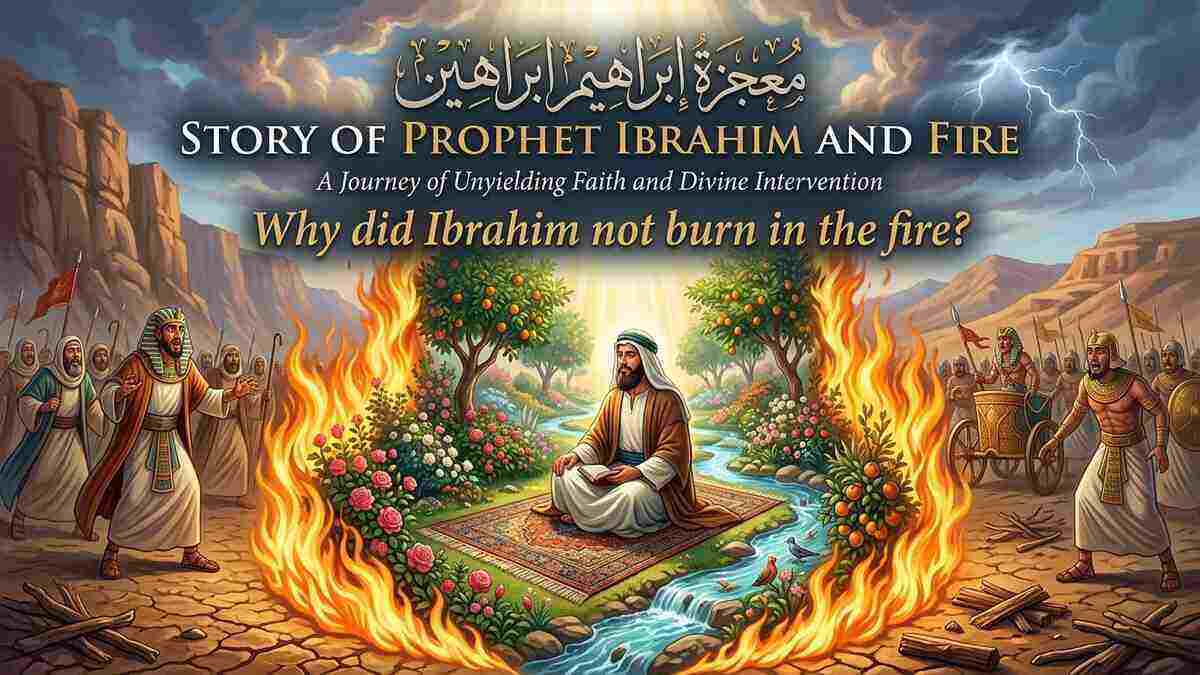
A young man smashes the idols his whole city worships, and the city answers by building a fire so large they can’t get near it. The story of Prophet Ibrahim and fire is one of the best-known moments in the Quran, and the line that ends it is only a few words long: “O fire, be coolness and safety upon Ibrahim.”
This guide covers what led up to the fire, what happened inside it, and what the Quran says compared with what later tradition adds. You’ll also get five lessons you can use.
Who Was Prophet Ibrahim (Abraham)?
Ibrahim (peace be upon him) is one of the greatest messengers in Islam. The Quran calls him Allah’s khalil, a close friend (4:125), and holds him up as a model of devotion. He is the father of Prophets Isma’il and Ishaq, and Prophet Muhammad is among his descendants.
Surah Al-Anbiya (21:60) describes him as a fata, a young man, when he first spoke out against idol worship. That detail is worth remembering: this story is about courage that starts early.
Why Did Ibrahim Challenge His People?
His own family and city worshipped idols. Ibrahim reasoned with them on every level.
The conversation with his father
In Surah Maryam (19:41-48), he speaks to his father with respect, asking why he worships things that can neither hear nor see nor help. His father threatens him and tells him to leave. Ibrahim responds with peace and says he will pray for him.
The search for truth
Surah Al-An’am (6:75-79) shows him looking at a star, the moon, and the sun, and rejecting each because they set. His conclusion is that he turns his face to the One who created the heavens and earth. This reasoning stays useful for anyone explaining faith to others.
How Did Ibrahim Break the Idols?
His people left town for a festival. Ibrahim stayed behind, entered their temple, and broke the idols into pieces, leaving only the largest one intact (21:58).
When the people returned, they asked who had done this. Someone remembered the young man who spoke against their gods. Ibrahim was brought before the crowd and asked directly. He replied, “Rather, this big one did it, so ask them, if they can speak” (21:63).
The effect was immediate. The Quran says they turned back to themselves and admitted, “You know well that these do not speak” (21:64-65). That was the moment of honesty. Yet instead of drawing the obvious conclusion, they doubled down.
Story of Prophet Ibrahim and Fire: The Verdict
The crowd decided on punishment: “Burn him and support your gods, if you are to act” (21:68). Think about what that shows. They couldn’t answer his argument, so they reached for force.
What tradition adds
The Quran gives no description of the fire’s size or how he was thrown in. Later tradition says a huge pit was filled with wood for days and that Ibrahim was launched from a catapult. These details come from commentary and narration, not the Quran, so treat them as background.
The ruler of the time is traditionally identified as Nimrod (Namrud). Surah Al-Baqarah (2:258) mentions a debate between Ibrahim and a king over who gives life and death, but doesn’t name him.
“O Fire, Be Coolness and Safety”
This is the center of the whole story. Allah says:
“We said, ‘O fire, be coolness and safety upon Ibrahim.'” (Surah Al-Anbiya, 21:69)
Scholars note the wording is precise: the command says coolness and safety. If the fire had only turned cool, the sudden change might have harmed him. Safety was added.
The dua of Ibrahim in the flames
Ibn Abbas reported in Sahih al-Bukhari that Ibrahim said “Hasbunallahu wa ni’mal wakeel” (Allah is enough for us, and He is the best protector) when he was thrown into the fire. Many Muslims recite it in times of fear and pressure.
What Happened After the Fire?
The people wanted to harm him, but Allah made them the losers (21:70). In Surah As-Saffat (37:98), the same idea appears: they plotted against him and Allah made them the lowest.
Ibrahim then left his homeland. He said, “I am going to my Lord; He will guide me” (37:99). From there began the journey that took him through Hajar, Makkah, and the building of the Ka’bah with his son Isma’il.
Quran vs Tradition at a Glance
| Detail | In the Quran? |
|---|---|
| Ibrahim broke the idols | Yes (21:58) |
| He left the largest idol intact | Yes (21:58) |
| The people decided to burn him | Yes (21:68) |
| The fire became cool and safe | Yes (21:69) |
| The ruler was Nimrod | Not named; from tradition |
| A catapult was used | Not mentioned; from tradition |
| The pit burned for many days | Not mentioned; from tradition |
Sticking to the first four rows keeps the story safe and accurate. The rest is useful context, if you label it as tradition.
5 Lessons from the Story of Prophet Ibrahim and Fire
- Stand for what’s right, even if you stand alone. He was a young man facing an entire city.
- Use reason, not just emotion. He argued with logic and kindness, from his father to the crowd.
- Trust Allah when no option is left. There was no escape plan, and none was needed.
- Opposition often exposes weakness. When his people ran out of answers, they reached for fire.
- Faith can mean leaving. After the fire, Ibrahim migrated for the sake of Allah, and Allah opened new doors.
Frequently Asked Questions
What is the story of Prophet Ibrahim and fire in short?
Prophet Ibrahim broke his people’s idols and challenged them to ask the idols who did it. Instead of accepting the truth, they threw him into a huge fire. Allah commanded the fire to be cool and safe for him, and he survived unharmed.
What did Allah say to the fire?
Allah said, “O fire, be coolness and safety upon Ibrahim” (Surah Al-Anbiya, 21:69).
Who threw Prophet Ibrahim into the fire?
The Quran says his people decided to burn him. Tradition names the ruler as Nimrod, but the Quran does not.
What did Ibrahim say when he was thrown into the fire?
According to Sahih al-Bukhari, he said “Hasbunallahu wa ni’mal wakeel,” meaning Allah is enough for us and the best protector.
Where is the story of Ibrahim and the fire in the Quran?
It appears mainly in Surah Al-Anbiya (21:51-70), with related passages in Surah As-Saffat (37:83-98) and Surah Al-Ankabut (29:16-27).
Conclusion
The story of Prophet Ibrahim and fire shows that when everything human fails, Allah’s command is enough. A young man with no army and no allies walked into the flames and walked out safe.
Next time you’re under pressure, say “Hasbunallahu wa ni’mal wakeel” and mean it. Then read Surah Al-Anbiya (21:51-70) in a translation you trust, and share this article with someone who could use the reminder.
