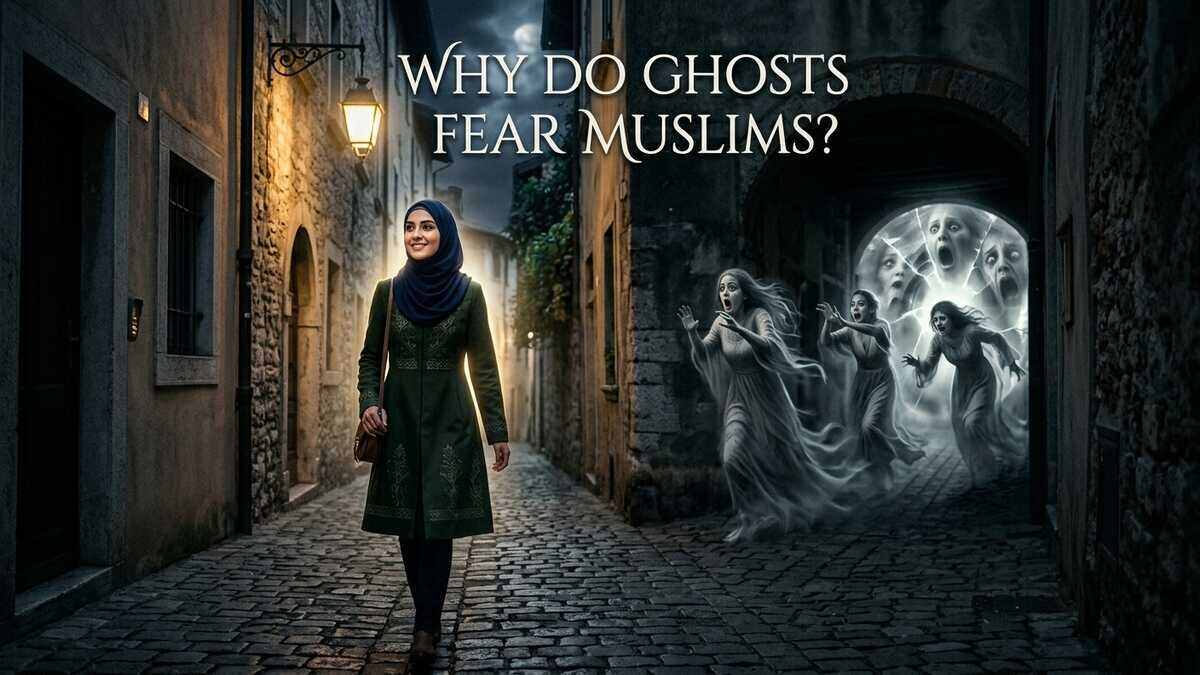
You wake at 3 a.m. The room is quiet, but it feels wrong. Maybe you heard a footstep. Maybe you felt a weight on your chest. Your first thought is simple and a little embarrassing: is something here?
If that sounds familiar, you’re not alone, and Islam has a clear, calm answer. This guide explains why ghosts cannot harm Muslims in the way horror films suggest, what the Quran and authentic hadith say about unseen beings, and the exact daily practices that give you real protection.
Are Jinn Ghosts in Islam?
No. In Islam, jinn are not ghosts. A ghost, in popular culture, is the spirit of a dead person who lingers on earth. Jinn are a separate creation: living, intelligent beings made by Allah from smokeless fire, just as humans were made from clay (Quran 55:14-15).
That difference matters, because it changes how a Muslim understands every strange experience.
What the Quran says jinn are
Jinn have free will. Some are believers, some aren’t, and the Quran says so directly in Surah Al-Jinn (chapter 72). Iblis, who refused to bow to Adam, was one of them (Quran 18:50). They eat, they marry, and they will be held accountable on the Day of Judgment.
They also live alongside us without being seen. Surah Al-A’raf (7:27) says Shaytan and his followers see us from where we can’t see them.
Where do the souls of the dead go?
Here’s the part many people miss. Mainstream Islamic teaching holds that when someone dies, their soul moves into the barzakh, a stage between death and resurrection (Quran 23:99-100). It does not stalk the earth, or haunt a house, or hang a loose argument.
So the idea of a dead relative’s spirit trapped in the hallway doesn’t fit the Islamic picture of death.
So what are people actually seeing?
Scholars have given several explanations over the centuries. Some encounters may be jinn, including a person’s qareen, the companion jinn assigned to every human, which can imitate voices or appearances, including those of the deceased. Others may be ordinary things: sleep paralysis, exhaustion, grief, anxiety, an old house settling at night.
Islam doesn’t ask you to ignore the unseen, and it doesn’t ask you to blame everything on it either. It asks for balance.
Can Ghosts Really Harm Muslims? What the Quran Says
Allah is the only one who decides what can or cannot harm you.This is the basis of the whole subject. Jinn have no independent power over you, and neither does anything else in creation.
Nothing happens without Allah’s permission
Surah Al-Mujadila (58:10) says Shaytan’s whispering is meant to make believers grieve, but he cannot harm them at all unless Allah permits it. The same principle appears about magic in Surah Al-Baqarah (2:102) and about every hardship in Surah At-Taghabun (64:11).
A well-known hadith in Tirmidhi, from Ibn Abbas, makes the same point from another angle: if the entire world gathered to harm you, they could only do what Allah had already written.
Shaytan’s plan is weak
The Quran uses a blunt phrase for the schemes of Shaytan: they are feeble (4:76). And Surah An-Nahl (16:99) says he has no authority over those who believe and put their trust in their Lord.
Think about what that means in practice. A believer who is anchored in prayer and remembrance isn’t a soft target. The fear is real. The power behind it is not.
A fair caveat: protection isn’t a promise of zero tests
I’d be misleading you if I said no Muslim ever faces harm from jinn. Islamic sources do speak of jinn affecting people, and scholars discuss envy, the evil eye and possession with care. The honest teaching is this: harm can only occur by Allah’s permission, and Allah has given every believer strong, simple tools to stay protected.
That’s why the phrase “ghosts cannot harm Muslims” is best understood as they cannot harm a Muslim who stays under Allah’s protection, not as a guarantee that nothing will ever trouble you.
Why Ghosts Cannot Harm Muslims Who Stay Close to Allah
Protection in Islam isn’t mystical or complicated. It’s built from short, authentic practices that fit into an ordinary day.
Ayat al-Kursi (Quran 2:255)
This is the most famous protective verse. In Sahih al-Bukhari, the companion Abu Hurayrah was guarding stored charity when a thief came at night. The thief turned out to be a devil, and he taught Abu Hurayrah this: recite Ayat al-Kursi before sleep and a guardian from Allah stays with you until morning, with no devil coming near. The Prophet ﷺ confirmed that the thief had told the truth, even though he was a liar by nature.
The last two verses of Surah Al-Baqarah
Both Bukhari and Muslim report that whoever recites these two verses at night, they will suffice him. Many scholars understand “suffice” to include protection from harm.
The three Quls
Aisha reported that before sleeping, the Prophet ﷺ would cup his hands, recite Surah Al-Ikhlas, Al-Falaq and An-Nas, blow into his palms, and wipe over as much of his body as he could reach (Sahih al-Bukhari). It takes under a minute.
Morning and evening adhkar
There’s a short dua, narrated by Uthman ibn Affan in Abu Dawud and Tirmidhi, that says: in the name of Allah, with whose name nothing on earth or in heaven can cause harm, and He is the All-Hearing, All-Knowing. Saying it three times in the morning and three times in the evening is a simple habit with enormous value.
When you stop somewhere new
Khawla bint Hakim reported in Sahih Muslim that whoever stops at a place and seeks refuge in Allah’s perfect words from the evil of what He created, nothing will harm them until they leave. That’s useful for travel, hotels, and moving into a new home.
Small habits at home
- The adhan: Bukhari and Muslim report that Shaytan runs away when the call to prayer is made.
- Surah Al-Baqarah: Sahih Muslim says Shaytan flees from a house where it’s recited.
- Bismillah at the door: Muslim also reports that when a person enters their home and mentions Allah, Shaytan tells his followers there’s no lodging and no dinner for them there.
Does Feeling Afraid Mean Your Faith Is Weak?
No, and this is worth saying plainly because so many people quietly believe it.
Fear is a human reaction, not a verdict on your iman. Even the Prophets felt it. Musa ﷺ felt fear when his staff turned into a snake, and Allah told him not to be afraid (Quran 20:67-68). Nobody scolded him for being startled. He was reassured.
What separates a believer from everyone else isn’t the absence of fear. It’s what they do with it. A frightened Muslim reaches for Allah: a verse, a dua, two rak’ahs. A frightened person without that anchor often reaches for charms, strangers online or panic.
So if your heart races at a creaking door, don’t spiral into guilt on top of the fear. Take it as a cue to remember Allah, and let the remembrance do its quiet work. Over weeks of steady dhikr, many people find the nights feel noticeably lighter. That isn’t magic. It’s the calm that comes from handing your worry to the One who controls everything, which is exactly why ghosts cannot harm Muslims who live this way.
Common Beliefs vs. What Islam Teaches
| Common belief | What Islam teaches |
|---|---|
| Ghosts are spirits of dead people stuck on earth | Souls of the dead are in the barzakh, not roaming the world |
| Ghosts and jinn are the same thing | Jinn are a separate creation made from smokeless fire |
| Ghosts can attack anyone at will | Nothing harms anyone except by Allah’s permission |
| Charms and talismans keep spirits away | Hanging amulets is warned against in hadith; Quran and dhikr are the protection |
| You need a spiritual healer to be safe | Every Muslim already has access to Allah’s protection through daily remembrance |
What a Muslim Should Avoid
Protection works best when you aren’t undermining it. A few things to stay away from:
- Amulets and charms. Abu Dawud reports that wearing tama’im (charms) is a form of shirk. Trusting an object over Allah is the opposite of tawakkul.
- Fortune tellers and psychics. Sahih Muslim says the prayer of a person who visits a fortune teller and asks them about the unseen isn’t accepted for forty nights.
- Ouija boards, summoning games and “ghost hunting” for fun. Surah Al-Jinn (72:6) describes people who sought refuge with jinn and only increased in fear and burden. The pattern hasn’t changed.
- Neglecting prayer. Missing salah leaves a gap that fear fills quickly. Praying on time is itself protection.
What to Do If You Feel Afraid at Night
If you’re scared right now, here’s a practical order of steps that scholars commonly recommend:
- Say “A’udhu billahi min ash-shaytan ir-rajim” and stay calm. Panic helps nobody.
- Recite Ayat al-Kursi out loud, slowly.
- Turn on a light and make wudu. Movement and water often break the spiral.
- Pray two rak’ahs if you can.
- Check the ordinary causes. Are you sleeping badly? Under stress? Did you experience sleep paralysis, which is a recognised medical condition?
- Speak to someone. A trusted family member, an imam, or a doctor if the fear keeps returning. Seeking medical or psychological help isn’t a lack of faith. The Prophet ﷺ encouraged treatment.
For ongoing, severe experiences, look for a qualified scholar who practices ruqyah according to the Quran and Sunnah, and be wary of anyone who charges large fees or uses unfamiliar words, objects or rituals.
Frequently Asked Questions
Why can’t ghosts harm Muslims?
Because Islam teaches that harm only occurs by Allah’s permission, and He has given believers protection through prayer, the Quran and daily dhikr. A Muslim who relies on Allah and keeps these practices is under His guardianship.
Are jinn and ghosts the same in Islam?
No. Jinn are living beings created from smokeless fire. Ghosts, as popularly imagined, are the spirits of the dead, and Islam teaches that those souls are in the barzakh, not wandering the earth.
Which dua protects from jinn?
Ayat al-Kursi, the last two verses of Surah Al-Baqarah, the three Quls, and the morning and evening adhkar are the best-known protections, all supported by authentic hadith.
Can jinn possess a Muslim?
Scholars differ on the details, and this is a topic where it’s wise to ask a qualified scholar rather than rely on internet claims. What’s agreed is that protection comes through Allah, and many experiences blamed on jinn have medical or psychological explanations worth ruling out.
Is it haram to believe in ghosts?
Believing in jinn is part of the Islamic creed because the Quran mentions them. What Islam rejects is the belief that dead people’s spirits haunt the world, and any belief that something other than Allah controls benefit and harm.
Conclusion: Fear Less, Remember More
The reason ghosts cannot harm Muslims who hold fast to their faith isn’t a trick or a charm. It’s tawakkul: knowing that every outcome rests with Allah, then doing the small daily things He taught us. A verse before sleep. A dua in the morning. A prayer on time.
Start tonight. Recite Ayat al-Kursi before bed, say the three Quls and wipe over your body, and notice how different the dark feels. Then share this guide with someone in your family who’s been losing sleep over the same fears.
This article is educational. For personal religious rulings, please consult a qualified scholar, and for persistent distress, a healthcare professional. Please check hadith references against a trusted source such as Sunnah.com before quoting them.

3 thoughts on “Why Ghosts Cannot Harm Muslims? (and What Islam Says About Jinn)”