If you live in London, Chicago, or anywhere else where Friday is also a workday, you know the feeling. The week is winding down, your inbox is full, and Jumu’ah is somewhere in the middle of it. It’s easy to treat the day as a scheduling problem instead of the gift it is.
The best Islamic hadith for Friday change that. In this guide you’ll find four authentic narrations in Arabic and English, each with its source, a clear explanation, and a practical way to act on it. You’ll also see how scholars handle the questions people ask most, from the hour of dua to going early.
What is the most important Islamic hadith for Friday?
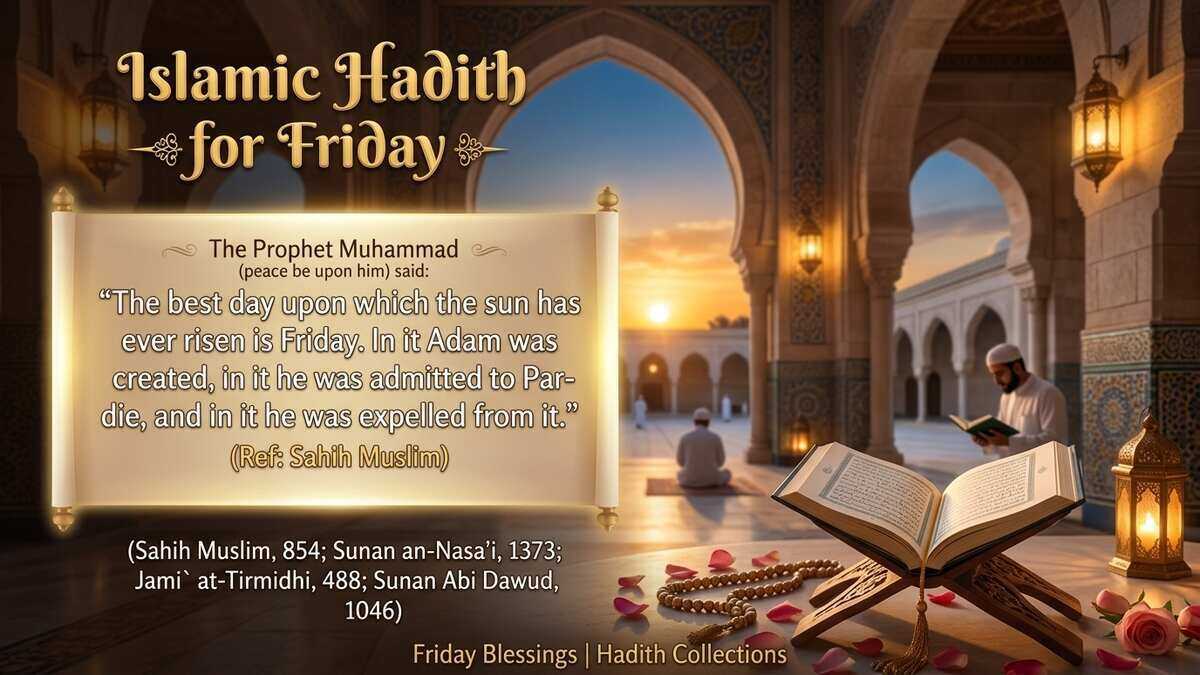
Short answer: it’s the narration in Sahih Muslim 854, where the Prophet ﷺ calls Friday the best day on which the sun has risen. Scholars agree on its authenticity, and it explains why the day carries so much weight.
Arabic text and English meaning
خَيْرُ يَوْمٍ طَلَعَتْ عَلَيْهِ الشَّمْسُ يَوْمُ الْجُمُعَةِ فِيهِ خُلِقَ آدَمُ وَفِيهِ أُدْخِلَ الْجَنَّةَ وَفِيهِ أُخْرِجَ مِنْهَا وَلاَ تَقُومُ السَّاعَةُ إِلاَّ فِي يَوْمِ الْجُمُعَةِ.
Abu Hurayrah (may Allah be pleased with him) reported that the Prophet ﷺ said: “The best day on which the sun has risen is Friday. On it Adam was created, on it he was admitted to Paradise, and on it he was removed from it. And the Hour will not be established except on Friday.”
Source: Sahih Muslim 854. Grade: authentic (Sahih Muslim).
What it means for your week
Friday is tied to beginnings: the creation of the first human being and his first home. That framing matters. The day isn’t just a deadline or a day off. It’s a reminder of where we come from and where we’re headed.
Treat it that way in practice. Plan Thursday night so Friday morning isn’t a scramble, and decide in advance what you’ll do differently.
What does the hadith say about the special hour of dua on Friday?
Short answer: the Prophet ﷺ said there is an hour on Friday in which Allah grants what a Muslim asks for, and he showed with his hand that it’s short. The narration is in Sahih al-Bukhari 935 and Sahih Muslim 852.
Arabic text and English meaning
ذَكَرَ يَوْمَ الْجُمُعَةِ فَقَالَ: فِيهِ سَاعَةٌ لاَ يُوَافِقُهَا عَبْدٌ مُسْلِمٌ وَهْوَ قَائِمٌ يُصَلِّي يَسْأَلُ اللَّهَ تَعَالَى شَيْئًا إِلاَّ أَعْطَاهُ إِيَّاهُ. وَأَشَارَ بِيَدِهِ يُقَلِّلُهَا.
Abu Hurayrah (may Allah be pleased with him) reported that the Messenger of Allah ﷺ mentioned Friday and said: “In it there is an hour. No Muslim servant happens to catch it while standing in prayer, asking Allah for something, except that Allah gives it to him.” And he motioned with his hand to show how brief it is.
Source: Sahih al-Bukhari 935; Sahih Muslim 852. Grade: agreed upon (Bukhari and Muslim).
When is the hour?
The hadith doesn’t say, and scholars have discussed it for centuries. One commonly cited view places it between the imam sitting on the pulpit and the end of the prayer. Another points to the last hour of the day. Since it isn’t pinned down, many scholars suggest asking throughout the day so you don’t miss it.
That’s practical advice. Keep a short list of things you want to ask for on your phone, and go through it at different points on Friday.
Why does the Prophet ﷺ encourage going early to Jumu’ah?
Short answer: because the reward grows the earlier you arrive. Sahih al-Bukhari 881 compares the first arrival to offering a camel and the last to offering an egg.
Arabic text and English meaning
مَنِ اغْتَسَلَ يَوْمَ الْجُمُعَةِ غُسْلَ الْجَنَابَةِ، ثُمَّ رَاحَ فَكَأَنَّمَا قَرَّبَ بَدَنَةً، وَمَنْ رَاحَ فِي السَّاعَةِ الثَّانِيَةِ فَكَأَنَّمَا قَرَّبَ بَقَرَةً، وَمَنْ رَاحَ فِي السَّاعَةِ الثَّالِثَةِ فَكَأَنَّمَا قَرَّبَ كَبْشًا أَقْرَنَ، وَمَنْ رَاحَ فِي السَّاعَةِ الرَّابِعَةِ فَكَأَنَّمَا قَرَّبَ دَجَاجَةً، وَمَنْ رَاحَ فِي السَّاعَةِ الْخَامِسَةِ فَكَأَنَّمَا قَرَّبَ بَيْضَةً، فَإِذَا خَرَجَ الإِمَامُ حَضَرَتِ الْمَلاَئِكَةُ يَسْتَمِعُونَ الذِّكْرَ.
Abu Hurayrah (may Allah be pleased with him) reported that the Prophet ﷺ said: “Whoever bathes on Friday as one bathes after major impurity and then sets out early is like one who offers a camel. Whoever goes in the second hour is like one who offers a cow, in the third a horned ram, in the fourth a chicken, and in the fifth an egg. When the imam comes out, the angels attend to listen to the reminder.”
Source: Sahih al-Bukhari 881. Grade: agreed upon (Bukhari and Muslim).
Making early arrival realistic
In a country where Jumu’ah happens in the middle of a workday, “early” can feel out of reach. Start with what you can control. Ask your manager about a longer lunch on Fridays, or shift your hours to make up the time. Many mosques in the US and UK run two or three khutbah slots, so look for the one that fits.
Even arriving ten minutes sooner than usual is a step toward what the hadith describes. The scholars who comment on this narration treat the reward as a ladder: earlier is better, and every rung counts.
Should you send more blessings on the Prophet ﷺ on Friday?
Short answer: yes. In Sunan Abi Dawud 1047, the Prophet ﷺ asked his community to send many blessings upon him on Friday. Hadith scholars including al-Albani graded the narration authentic, and al-Nawawi called its chain sound.
Arabic text and English meaning
إِنَّ مِنْ أَفْضَلِ أَيَّامِكُمْ يَوْمَ الْجُمُعَةِ فِيهِ خُلِقَ آدَمُ وَفِيهِ قُبِضَ وَفِيهِ النَّفْخَةُ وَفِيهِ الصَّعْقَةُ فَأَكْثِرُوا عَلَىَّ مِنَ الصَّلاَةِ فِيهِ فَإِنَّ صَلاَتَكُمْ مَعْرُوضَةٌ عَلَىَّ.
Aws ibn Aws (may Allah be pleased with him) reported that the Messenger of Allah ﷺ said: “Among the best of your days is Friday. On it Adam was created and on it he died. On it the trumpet will be blown and on it the Shout will come. So send many blessings upon me on that day, for your blessings are presented to me.”
Source: Sunan Abi Dawud 1047. Grade: Sahih (al-Albani); chain sound per al-Nawawi.
The Companions asked how their blessings could be presented to him after his body had decayed. He replied that Allah has forbidden the earth from consuming the bodies of the prophets.
You don’t need a long formula. A simple Allahumma salli ‘ala Muhammad said throughout the day, on the train, while cooking, or waiting in a queue, follows the hadith.
Islamic hadith for Friday: quick reference
| Teaching | Source | Main lesson | Grade |
| Friday is the best day the sun has risen on | Muslim 854 | The day carries unique virtue | Sahih Muslim |
| An hour in which dua is answered | Bukhari 935; Muslim 852 | Ask often; the exact time is not specified | Agreed upon |
| Going early earns greater reward | Bukhari 881 | Arrive early for Jumu’ah | Agreed upon |
| Send more blessings on the Prophet ﷺ | Abu Dawud 1047 | Make salawat a Friday habit | Sahih (al-Albani) |
How to read the grades
“Agreed upon” means both Imam al-Bukhari and Imam Muslim recorded the hadith, which is the highest level of confidence in the hadith sciences. “Sahih” means authentic. When a hadith appears in more than one collection, you can cross-check the wording yourself. Build one habit: collection name, number, grade.
How can you make Friday count?
Knowing the Islamic hadith for Friday is the first step. Acting on them is the point. Here’s a simple plan you can start this week.
- Prepare the night before. Lay out clean clothes. Bukhari 877 records the Prophet’s instruction to bathe before Jumu’ah, and scholars discuss whether it’s obligatory or strongly recommended.
- Leave a little earlier. Even ten minutes changes the day.
- Say salawat. Pick a few moments, like your commute or your lunch walk.
- Ask in your own words. Keep your short list ready for the hour of dua.
- Read Surah al-Kahf. Many scholars recommend it on Fridays. The narrations about it have been graded differently, so present it as a recommended practice and cite your source.
Three mistakes to avoid
Forwarding unsourced “Friday hadith.” Social media is full of images attributing specific rewards to the day with no collection or number. If you can’t trace it, don’t share it.
Claiming to know the exact hour. The narrations leave it open. Confident posts that name a specific minute go beyond the evidence.
Treating Friday as only the khutbah. The day starts at dawn. The hadith above cover preparation, arrival, dua, and salawat, not just the sermon.
Frequently asked questions about Islamic hadith for Friday
Is Friday the best day of the week in Islam?
Yes. Sahih Muslim 854 says the best day on which the sun has risen is Friday. Scholars agree on this narration. The Prophet ﷺ linked the day to major events, including the creation of Adam.
What time is the special hour of dua on Friday?
The narrations don’t name an exact time, and scholars have given different answers. Two views are commonly cited: from when the imam sits on the pulpit until the prayer ends, or the last hour before sunset. Many scholars suggest making dua throughout the day.
Is there a specific dua to make on Friday?
The narrations in this article don’t prescribe one wording. Bukhari 935 says the person asks Allah for something good. You can ask for anything lawful and beneficial, in any language, in your own words.
Do I have to attend Jumu’ah if I work in the US or UK?
Scholars generally treat Friday prayer as obligatory for adult men who are residents and able, with exceptions such as illness or travel. If your job makes it hard, talk to your manager early. Many workplaces will adjust a lunch break, and many mosques offer more than one khutbah time.
Where can I find a hadith for Friday in English with the Arabic text?
Search by collection and number: Muslim 854, Bukhari 935, Bukhari 881, or Abu Dawud 1047. Sunnah.com lists each one with Arabic and English side by side. Always check the number so you know exactly what you’re reading.
Your next step
Pick one thing from this list and do it this Friday. Maybe it’s arriving ten minutes early, or saying salawat on your commute. Then explore more hadith and Islamic learning at Deen Truth Hub, where every reference is tied to its source so you can check it yourself.
PUBLISHING NOTES (not part of the article)
FAQPage JSON-LD schema
{
“@context”: “https://schema.org”,
“@type”: “FAQPage”,
“mainEntity”: [
{
“@type”: “Question”,
“name”: “Is Friday the best day of the week in Islam?”,
“acceptedAnswer”: {
“@type”: “Answer”,
“text”: “Yes. Sahih Muslim 854 says the best day on which the sun has risen is Friday. Scholars agree on this narration. The Prophet ﷺ linked the day to major events, including the creation of Adam.”
}
},
{
“@type”: “Question”,
“name”: “What time is the special hour of dua on Friday?”,
“acceptedAnswer”: {
“@type”: “Answer”,
“text”: “The narrations don’t name an exact time, and scholars have given different answers. Two views are commonly cited: from when the imam sits on the pulpit until the prayer ends, or the last hour before sunset. Many scholars suggest making dua throughout the day.”
}
},
{
“@type”: “Question”,
“name”: “Is there a specific dua to make on Friday?”,
“acceptedAnswer”: {
“@type”: “Answer”,
“text”: “The narrations in this article don’t prescribe one wording. Bukhari 935 says the person asks Allah for something good. You can ask for anything lawful and beneficial, in any language, in your own words.”
}
},
{
“@type”: “Question”,
“name”: “Do I have to attend Jumu’ah if I work in the US or UK?”,
“acceptedAnswer”: {
“@type”: “Answer”,
“text”: “Scholars generally treat Friday prayer as obligatory for adult men who are residents and able, with exceptions such as illness or travel. If your job makes it hard, talk to your manager early. Many workplaces will adjust a lunch break, and many mosques offer more than one khutbah time.”
}
},
{
“@type”: “Question”,
“name”: “Where can I find a hadith for Friday in English with the Arabic text?”,
“acceptedAnswer”: {
“@type”: “Answer”,
“text”: “Search by collection and number: Muslim 854, Bukhari 935, Bukhari 881, or Abu Dawud 1047. Sunnah.com lists each one with Arabic and English side by side. Always check the number so you know exactly what you’re reading.”
}
}
]
}
Internal linking opportunities
- In the intro: link “Jumu’ah” to a page explaining Friday prayer.
- In the salawat section: link to a page on durood or salawat.
- In the dua section: link to a page on duas for daily life.
- Near the end: link to your other hadith articles, such as the hadith about mother post.
No page URLs were provided. Confirm each page exists on deentruthhub.com before linking.
Image placement and alt text
- After the intro: “Worshippers entering a mosque on Friday for Jumu’ah prayer.”
- After the first hadith: “Open Arabic hadith book beside an English translation of a Friday hadith.”
- In the practice section: “Person holding a short dua list while walking to the mosque on Friday.”
E-E-A-T and verification notes
Arabic wording and numbering were checked against Sunnah.com for Bukhari 935 and 881, Muslim 854, and Abu Dawud 1047. Sahih Muslim 852 was cross-checked via secondary sources. Opinions on the hour of dua are summarized from commentary and are not exhaustive. The Surah al-Kahf and Bukhari 877 points are stated in hedged terms because scholars differ on grading and rulings; verify against your preferred scholar before publishing. English renderings are plain-language meanings written for this article. Add an author or reviewer byline with real credentials and have a qualified scholar approve the explanations.
