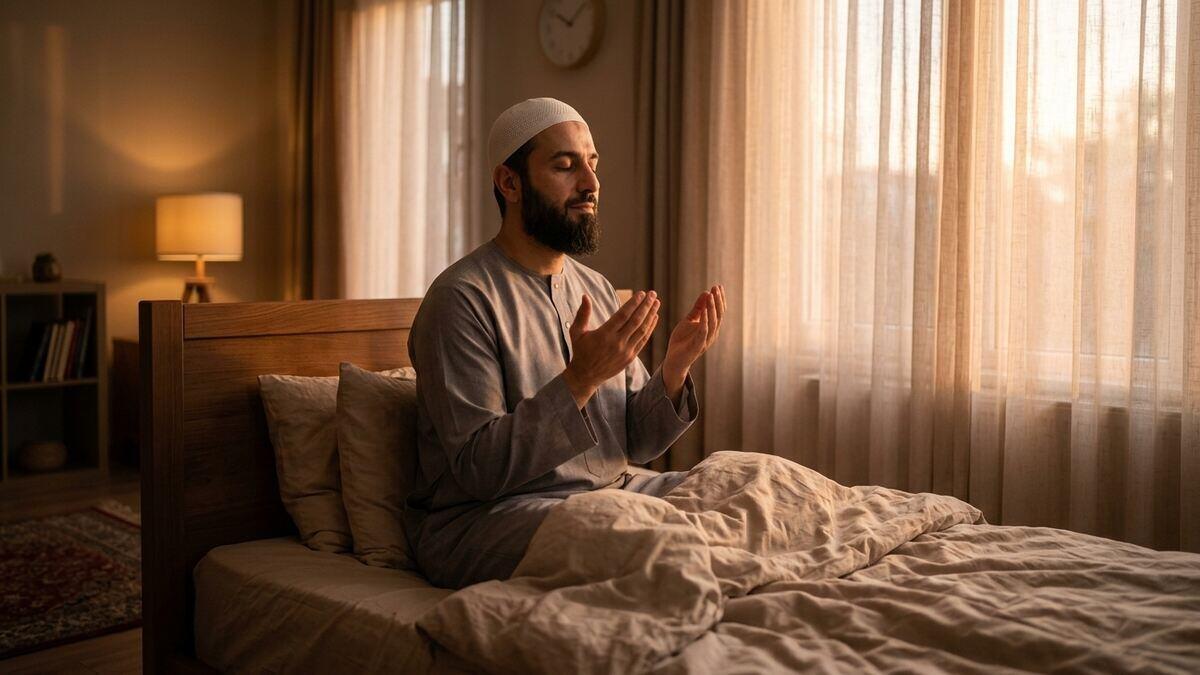
The alarm goes off, your hand finds the phone, and within ten seconds you’re reading messages that have nothing to do with Allah. Most of us start the day that way, and then wonder why the morning feels rushed and empty. The Prophet ﷺ gave us a better first minute. This guide shares five authentic dua when waking up, plus what to say if you wake in the middle of the night, with the Arabic, the meaning and the source, so your mornings begin with barakah at Deen Truth Hub.
What Is the Dua When Waking Up From Sleep?
The dua when waking up from sleep is “Alhamdu lillahil-ladhi ahyana ba’da ma amatana wa ilayhin-nushur,” meaning “All praise is for Allah who gave us life after He caused us to die, and to Him is the resurrection.” It’s reported in Sahih al-Bukhari and Sahih Muslim.
Sleep is described as a minor death, which is why the words match so closely. You’ve been, in a sense, taken away and returned. The first thing you owe is thanks.
The waking dua in Arabic, transliteration and meaning
Arabic: الْحَمْدُ لِلَّهِ الَّذِي أَحْيَانَا بَعْدَ مَا أَمَاتَنَا وَإِلَيْهِ النُّشُورُ
Transliteration: Alhamdu lillahil-ladhi ahyana ba’da ma amatana wa ilayhin-nushur.
Meaning: “All praise is for Allah, who gave us life after having caused us to die, and to Him is the resurrection.”
Say it before you sit up, and before you touch your phone. If you forget, say it as soon as you remember. There’s no penalty for forgetting, only a missed head start.
5 Powerful Dua When Waking Up for a Blessed Morning
1. The dua when you first open your eyes
That’s the one above. It takes five seconds. The reward is a day that starts with gratitude instead of scrolling. Many people tape a small card beside the bed with the first line on it, and within a week it becomes automatic.
2. The morning dua of entering the day
Arabic: اللَّهُمَّ بِكَ أَصْبَحْنَا، وَبِكَ أَمْسَيْنَا، وَبِكَ نَحْيَا، وَبِكَ نَمُوتُ، وَإِلَيْكَ النُّشُورُ
Transliteration: Allahumma bika asbahna, wa bika amsayna, wa bika nahya, wa bika namutu, wa ilaykan-nushur.
Meaning: “O Allah, by You we reach the morning, by You we reach the evening, by You we live, by You we die, and to You is the resurrection.”
It’s reported in Sunan Abi Dawud and Jami at-Tirmidhi. In the evening, the last phrase changes to “wa ilaykal-masir” (and to You is the final return). Say it after Fajr or whenever you start your morning remembrance. It’s a small reminder that your plans don’t actually run the day. Allah does.
3. The dua for beneficial knowledge, good provision and accepted deeds
Arabic: اللَّهُمَّ إِنِّي أَسْأَلُكَ عِلْمًا نَافِعًا، وَرِزْقًا طَيِّبًا، وَعَمَلًا مُتَقَبَّلًا
Transliteration: Allahumma inni as’aluka ‘ilman nafi’an, wa rizqan tayyiban, wa ‘amalan mutaqabbalan.
Meaning: “O Allah, I ask You for beneficial knowledge, good provision and accepted deeds.”
Umm Salamah (RA) reported that the Prophet ﷺ used to say this after the Fajr salam (Sunan Ibn Majah). It’s the most direct dua for morning barakah because it covers the three things you need for the day: knowledge to use, provision to live on and deeds that Allah accepts. Scholars have discussed the grading of this narration, and many accept it. If you prefer extra caution, check with a teacher you trust.
4. Barakah in the early hours
Arabic: اللَّهُمَّ بَارِكْ لِأُمَّتِي فِي بُكُورِهَا
Transliteration: Allahumma barik li-ummati fi bukuriha.
Meaning: “O Allah, bless my nation in its early mornings.”
The Prophet ﷺ made this dua for his ummah, as reported in Sunan Abi Dawud and Jami at-Tirmidhi. Think about what that means. He asked for blessing specifically in the early hours, which is why a person who wakes for Fajr often feels like the day is longer. It’s a good reason to stop hitting snooze.
5. The dua for light, especially when waking for night prayer
Arabic: اللَّهُمَّ اجْعَلْ فِي قَلْبِي نُورًا، وَفِي بَصَرِي نُورًا، وَفِي سَمْعِي نُورًا
Transliteration: Allahumma-j’al fi qalbi nuran, wa fi basari nuran, wa fi sam’i nuran.
Meaning: “O Allah, place light in my heart, light in my sight and light in my hearing.”
This is the beginning of a longer dua that the Prophet ﷺ made when he got up at night to pray (Sahih al-Bukhari and Sahih Muslim). It’s lovely for anyone who wakes for tahajjud, but you can also use it as the first thing you ask for when you sit up.
Dua for Waking Up at Night: What to Say
You wake at 3 a.m. Your heart is pounding, or your mind is racing, or you’re simply awake. Most people reach for the phone. The Sunnah gives you something better.
The dua for waking up at night is “La ilaha illallahu wahdahu la sharika lah, lahul-mulku wa lahul-hamd, wa huwa ‘ala kulli shay’in qadir. Alhamdu lillah, wa subhanallah, wa la ilaha illallah, wallahu akbar, wa la hawla wa la quwwata illa billah.” The Prophet ﷺ said that whoever says this when waking at night and then asks Allah for forgiveness or makes any dua will have it answered, and if he makes wudu and prays, his prayer will be accepted (Sahih al-Bukhari).
Arabic: لَا إِلَهَ إِلَّا اللَّهُ وَحْدَهُ لَا شَرِيكَ لَهُ، لَهُ الْمُلْكُ وَلَهُ الْحَمْدُ وَهُوَ عَلَى كُلِّ شَيْءٍ قَدِيرٌ، الْحَمْدُ لِلَّهِ، وَسُبْحَانَ اللَّهِ، وَلَا إِلَهَ إِلَّا اللَّهُ، وَاللَّهُ أَكْبَرُ، وَلَا حَوْلَ وَلَا قُوَّةَ إِلَّا بِاللَّهِ
Transliteration: La ilaha illallahu wahdahu la sharika lah, lahul-mulku wa lahul-hamdu wa huwa ‘ala kulli shay’in qadir. Alhamdu lillah, wa subhanallah, wa la ilaha illallah, wallahu akbar, wa la hawla wa la quwwata illa billah.
Meaning: “There is no god but Allah alone, with no partner. His is the dominion and His is the praise, and He has power over all things. Praise be to Allah, glory be to Allah, there is no god but Allah, Allah is greatest, and there is no power or might except with Allah.”
Other Sunnah steps when you wake at night
- Wipe the sleep from your face. The Prophet ﷺ did this, then recited the last ten verses of Surah Ali Imran (3:190-200), as reported in Sahih al-Bukhari and Sahih Muslim.
- Use the siwak or brush your teeth. Hudhayfah (RA) reported the Prophet ﷺ cleaned his mouth with the siwak when he rose at night (Sahih al-Bukhari).
- Make wudu and pray. Even two light rak’ahs count.
- Ask for what you need. The last third of the night is a time when dua is especially hopeful.
A hadith in Sahih al-Bukhari describes three knots that Shaytan ties on a sleeper’s head. Remembering Allah undoes the first, wudu undoes the second and prayer undoes the third, and the person gets up energetic and in good spirits. If you’ve ever dragged yourself up feeling heavy, you know the opposite is real too.
Which Dua When Waking Up Should You Say, and When?
It helps to see everything side by side. Use this as a quick reference, and pin it near your bed.
| Moment | What to say | Source |
|---|---|---|
| The second you wake | Alhamdu lillahil-ladhi ahyana | Bukhari, Muslim |
| Waking in the night | La ilaha illallahu wahdahu… then dua | Bukhari |
| Getting up to pray at night | Allahumma-j’al fi qalbi nuran | Bukhari, Muslim |
| After Fajr | Allahumma inni as’aluka ‘ilman nafi’an | Ibn Majah |
| Starting your morning remembrance | Allahumma bika asbahna | Abu Dawud, Tirmidhi |
| Any early morning | Allahumma barik li-ummati fi bukuriha | Abu Dawud, Tirmidhi |
Why Your First Minute Matters More Than You Think
Here’s the uncomfortable truth. A morning that starts with a screen tends to stay on the screen. You tell yourself you’ll check one message, and twenty minutes later Fajr has passed or you’re praying it in a rush. That’s a small loss that repeats every day, and over a year it adds up to a lot of missed calm.
Now the encouraging side. The Prophet ﷺ didn’t ask for hours of effort at dawn. He gave short, easy words. Five seconds of gratitude doesn’t change your schedule, but it changes your direction. Plenty of people find that one steady habit at the start of the day makes the others easier to keep.
If it feels hard, remember that you’re not trying to become a different person overnight. You’re replacing the first ten seconds of your morning, nothing more.
A Simple Morning Routine You Can Keep
Big routines collapse by Wednesday. Small ones survive. Here’s a version that takes under ten minutes.
- Before you sit up: Say the waking dua.
- Clean up: Use the siwak, make wudu and say Bismillah.
- Fajr: Pray it on time, even if it’s short.
- After the salam: Recite the dua for beneficial knowledge and good provision.
- Morning adhkar: Add “Allahumma bika asbahna” and any remembrance you can sustain.
- Then, and only then, check your phone.
In places like Dhaka, Fajr can come well before 5 a.m. in the warmer months, so a short routine you’ll actually do beats a long one you’ll abandon. Check your local prayer timetable and build backward from it.
Common Mistakes With Dua When Waking Up
- Reaching for the phone first. A notification can hijack your mood before you’ve said a word of gratitude.
- Skipping Fajr but saying the dua. The dua is a companion to prayer, not a substitute.
- Saying it on autopilot. Even once, say it slowly and mean the words.
- Giving up after forgetting. Say it when you remember. The goal is progress.
- Overloading a new routine. Start with one dua for a week and add another.
- Treating a dua as a lucky charm. The reward comes from remembering Allah and then acting on that remembrance.
Make It a Family Habit
Mornings are easier when someone shares them. A hadith in Sunan Abi Dawud says Allah has mercy on a man who gets up at night to pray and wakes his wife to pray too, and on a woman who does the same for her husband. If you’re married, saying these duas together builds a quiet partnership. Our guide to the best dua for marriage in Islam covers supplications for just that kind of household. For more ideas on waking duas, DeenUp has a short guide to the dua for waking up as well.
Frequently Asked Questions About Dua When Waking Up
What is the dua when waking up in the morning?
It’s “Alhamdu lillahil-ladhi ahyana ba’da ma amatana wa ilayhin-nushur,” reported in Sahih al-Bukhari and Sahih Muslim. It means praise is for Allah who gave us life after causing us to die, and to Him is the resurrection.
What is the dua for waking up at night?
The Prophet ﷺ taught reciting “La ilaha illallahu wahdahu la sharika lah…” and then asking Allah for forgiveness or anything else, as reported in Sahih al-Bukhari. Making wudu and praying afterward is encouraged.
What if I forget to say the dua when I wake up?
Say it as soon as you remember. There’s no penalty, and building a habit is more important than perfection.
Can I say the dua in my own language?
The Arabic wording is preferred because it’s what the Prophet ﷺ taught. You can also add your own words of thanks in any language, and learning the Arabic over time is a worthwhile goal.
Should I say the dua before getting out of bed?
Yes. It’s best to say it right as you wake, before sitting up or checking your phone, though any time that morning is still valid.
Conclusion: Start Tomorrow With One Dua
You don’t need a perfect routine to get morning barakah. You need one dua, said consistently, before anything else grabs your attention. Tonight, put your phone across the room and write the first dua on a card by your bed. Tomorrow, say it before you move. If this guide helped, share it with a family member who struggles with mornings, and explore more practical Islamic guides at Deen Truth Hub. Tell us in the comments which dua you’re starting with.
A note on accuracy: this article reflects mainstream Sunni sources. For personal religious questions, speak with a qualified local scholar.
