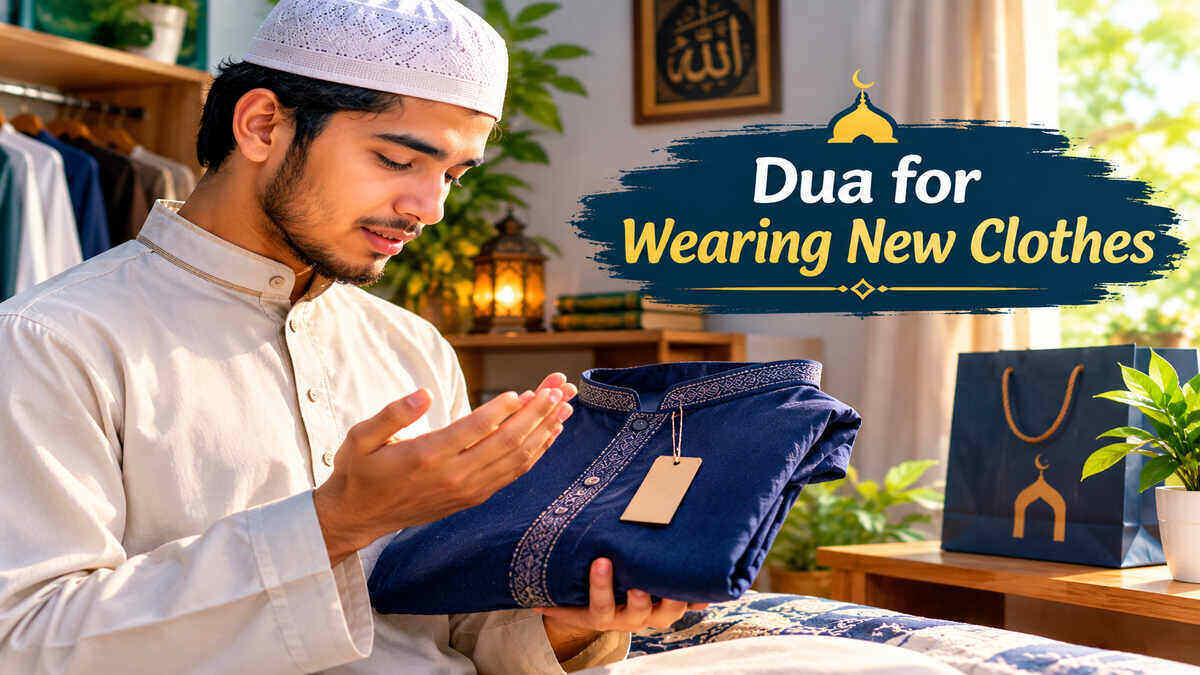
You’ve just unwrapped something new. Maybe it’s an Eid outfit, a wedding suit or simply a shirt you’ve wanted for months. The excitement is real, and so is the question: is there something I’m supposed to say? There is. This guide covers the dua for wearing new clothes with the Arabic, the meaning and the source, plus three easy steps to make a simple moment an act of gratitude at Deen Truth Hub.
What Is the Dua for Wearing New Clothes?
The dua for wearing new clothes is “Allahumma lakal-hamdu anta kasawtanihi, as’aluka khayrahu wa khayra ma suni’a lahu, wa a’udhu bika min sharrihi wa sharri ma suni’a lahu.” It means: “O Allah, all praise is Yours, You have clothed me with it. I ask You for its goodness and the goodness of what it was made for, and I seek refuge in You from its evil and the evil of what it was made for.” It’s reported in Sunan Abi Dawud and Jami at-Tirmidhi.
Abu Sa’id al-Khudri (RA) reported that when the Prophet ﷺ put on something new, whether a turban, a shirt or a cloak, he would name it and then say this dua. That detail is lovely. He didn’t treat it as a generic item. He named the garment and thanked Allah for it.
The dua for new clothes in Arabic, transliteration and meaning
Arabic: اللَّهُمَّ لَكَ الْحَمْدُ أَنْتَ كَسَوْتَنِيهِ، أَسْأَلُكَ مِنْ خَيْرِهِ وَخَيْرِ مَا صُنِعَ لَهُ، وَأَعُوذُ بِكَ مِنْ شَرِّهِ وَشَرِّ مَا صُنِعَ لَهُ
Transliteration: Allahumma lakal-hamdu anta kasawtanihi, as’aluka khayrahu wa khayra ma suni’a lahu, wa a’udhu bika min sharrihi wa sharri ma suni’a lahu.
Meaning: “O Allah, to You belongs all praise. You have clothed me with it. I ask You for its good and the good for which it was made, and I seek refuge in You from its evil and the evil for which it was made.”
3 Easy Steps for the Dua for Wearing New Clothes
You don’t need a special setting or a long routine. These three steps take about thirty seconds.
Step 1: Begin with Bismillah and the right side
Before you put anything on, say “Bismillah.” Then start with the right sleeve or right leg. The Prophet ﷺ liked to begin with the right side in his affairs, as reported in Sahih al-Bukhari and Sahih Muslim, and Abu Hurayrah (RA) narrates in Sunan Abi Dawud that when you dress, you should begin with your right.
It’s a simple habit that quietly turns every morning’s routine into a small act of remembrance.
Step 2: Name the garment and say the dua
Say, for example, “Allahumma lakal-hamdu, anta kasawtanihi” and, if you like, name the item aloud or in your heart: this shirt, this scarf, this thobe. Then continue with the rest of the dua. If you don’t know the Arabic yet, say the first line and ask for the rest in your own words. Allah understands every language.
Step 3: Be grateful, humble and generous
The dua asks for the goodness of the clothing and protection from its evil. What’s the “evil” in a garment? Pride. Waste. Showing off. Wearing something at the expense of someone else’s dignity. The Prophet ﷺ said, according to Sunan an-Nasa’i and Musnad Ahmad, to eat, drink, give charity and dress without extravagance or arrogance.
So the third step is a quiet one: wear it with humility, and consider giving away something you no longer need. A shirt sitting unused in your wardrobe could keep someone else warm.
Other Duas When Wearing Clothes
The dua for putting on any clothing
There’s a second dua you can say whenever you dress, not just for something new.
Arabic: الْحَمْدُ لِلَّهِ الَّذِي كَسَانِي هَذَا وَرَزَقَنِيهِ مِنْ غَيْرِ حَوْلٍ مِنِّي وَلَا قُوَّةٍ
Transliteration: Alhamdu lillahil-ladhi kasani hadha wa razaqanihi min ghayri hawlin minni wa la quwwah.
Meaning: “All praise is for Allah who clothed me with this and provided it for me without any power or strength from myself.”
The Prophet ﷺ said that whoever says this when he puts on a garment will have his previous sins forgiven (Sunan Abi Dawud and Jami at-Tirmidhi). Scholars have discussed the grading of this narration, and many accept it. Either way, the words are a sincere thanks and carry no harm.
The dua to make for someone else’s new clothes
Umm Khalid (RA) reported that the Prophet ﷺ gave her a small garment and told her to wear it and wear it out, saying “Ibli wa akhliqi” (Sahih al-Bukhari).
Arabic: أَبْلِي وَأَخْلِقِي
Transliteration: Ibli wa akhliqi.
Meaning: “May you wear it out and make it old.”
It’s a loving wish for a long, healthy life. Say it to a child in a new Eid outfit or a friend in new clothes. Another narration in Sunan Abi Dawud has the Prophet ﷺ saying to someone in new clothes, “Tubli wa yukhlifullahu ta’ala,” meaning may you wear it out and may Allah replace it. If you prefer, you can simply say “Mubarak” and add a short dua.
Which Dua for New Clothes Should You Say?
| Situation | What to say | Source |
|---|---|---|
| Wearing something brand new | Allahumma lakal-hamdu anta kasawtanihi… | Abu Dawud, Tirmidhi |
| Dressing in the morning | Alhamdulillahil-ladhi kasani hadha… | Abu Dawud, Tirmidhi |
| Seeing someone in new clothes | Ibli wa akhliqi | Bukhari |
| Starting to dress | Bismillah, then the right side | Bukhari, Muslim, Abu Dawud |
Why Clothing Matters in Islam
Clothing is a blessing, not an afterthought. The Qur’an says, “O children of Adam, We have bestowed upon you clothing to cover your private parts and as adornment, but the clothing of righteousness is best” (Surah al-A’raf, 7:26). Notice the order. First comes covering, then beauty, and then the quiet reminder that character matters most.
The same chapter tells us to take our adornment at every place of prayer, and to eat and drink without waste (7:31). Islam isn’t against nice clothes. Another narration in Jami at-Tirmidhi says that Allah loves to see the effect of His blessings on His servant. Looking presentable is a form of gratitude. The line is crossed when a garment becomes a tool for pride.
The good side of new clothes
New clothes are often tied to happy memories. Eid morning, a wedding day, a child’s first day of school. In places like Dhaka, Karachi or Delhi, the weeks before Eid are a flurry of tailors and markets, and a dua for new clothes turns that excitement into worship. It’s one of those small moments where joy and gratitude can meet.
The warning attached to them
There’s an honest flip side. Clothing can feed vanity. It can encourage overspending, debt and the quiet competition of who wore what. And it can create pressure on families who can barely afford it. The dua’s request for protection from the “evil” of the garment is a real safeguard against all of that.
Eid, Weddings and Special Occasions
Scholars recommend wearing your best clothes on Eid and on Fridays, and many families buy something new for the occasion. If you’re preparing for a wedding, the same dua applies to a wedding outfit, and it’s a lovely thing to say before the nikah. Our guide to the best dua for marriage in Islam has supplications for the couple and their new life together.
A few practical thoughts for these occasions:
- Set a budget before you shop. Overspending turns a blessing into a burden.
- Include someone in need. Buy one extra outfit for a relative, neighbor or family you know is struggling.
- Teach children the dua. A child who says “Alhamdulillah” for a new shirt is learning gratitude early.
- Wash or air out new clothes if you prefer, but don’t delay the dua. Say it when you first put them on.
Teaching Children the Dua for Wearing New Clothes
Children remember what they do, not what they’re told. New clothes are one of the easiest moments to teach gratitude because they’re already excited.
Try this routine the next time your child gets a new outfit:
- Let them hold it first. Ask, “Who gave us this?” and let them answer.
- Say the first line together. “Allahumma lakal-hamdu” is short enough for a four-year-old.
- Explain one idea in simple words. “We say thank you to Allah, because He gave us clothes, and some people don’t have enough.”
- Pass something on. Let them choose an outgrown outfit to give away. Children who give early tend to keep the habit.
Expect some resistance. A child in a hurry to show off a new shirt won’t stand still for a lesson, and that’s fine. Keep it light, keep it short, and don’t turn it into a scolding. If they skip it today, remind them gently tomorrow.
Parents often ask whether it’s too early to start. It isn’t. Children pick up Arabic phrases the way they pick up songs, through repetition and warmth. By the time they can read, the dua will already feel like home.
Common Mistakes With the Dua for Wearing New Clothes
- Skipping it because it’s “just clothes.” The Prophet ﷺ made it for a turban and a shirt. Nothing is too small.
- Reading without understanding. Take ten seconds to think about what you’re saying.
- Wearing clothes with pride. The dua’s whole point is protection from arrogance and waste.
- Hoarding old clothes. A full wardrobe with unworn items is a missed chance for charity.
- Assuming a long dua is required. The Sunnah is short. Even the first line is better than silence.
- Treating a grading debate as a reason to skip gratitude. Even if you’re unsure about a narration, thanking Allah is never wrong.
Frequently Asked Questions About the Dua for Wearing New Clothes
What is the dua for wearing new clothes in Islam?
It’s “Allahumma lakal-hamdu anta kasawtanihi, as’aluka khayrahu wa khayra ma suni’a lahu, wa a’udhu bika min sharrihi wa sharri ma suni’a lahu,” reported in Sunan Abi Dawud and Jami at-Tirmidhi.
Do I have to say the dua every time I wear something new?
It’s a recommended Sunnah, not an obligation. Saying it each time you put on a new item is a good habit and costs you only a few seconds.
What do you say to someone wearing new clothes?
You can say “Ibli wa akhliqi,” which the Prophet ﷺ said to Umm Khalid, meaning may you wear it out and make it old. Another narration has “Tubli wa yukhlifullahu ta’ala.”
Should I start with the right side when dressing?
Yes. Starting with the right is a recommended Sunnah when putting on clothes, as reported in Sunan Abi Dawud and the general practice of the Prophet ﷺ in Sahih al-Bukhari and Sahih Muslim.
Can I make the dua in my own language?
Yes. Saying the Arabic is best, and you can add your own words of thanks in any language. Learn the Arabic over time and keep your own words as a bridge.
Conclusion: Say It Before You Step Out
The dua for wearing new clothes takes less time than choosing which shoes to wear, and it changes what the moment means. Say Bismillah, start with the right side, thank Allah for the garment and wear it with humility. This week, put the dua on a card inside your wardrobe so it’s the first thing you see when you open it. If this guide helped, share it with a family member before Eid, and explore more practical Islamic guides at Deen Truth Hub. Tell us in the comments which dua you’re starting with.
A note on accuracy: this article reflects mainstream Sunni sources. Where a narration’s grading is discussed among scholars, we’ve said so. For personal religious questions, speak with a qualified local scholar.
