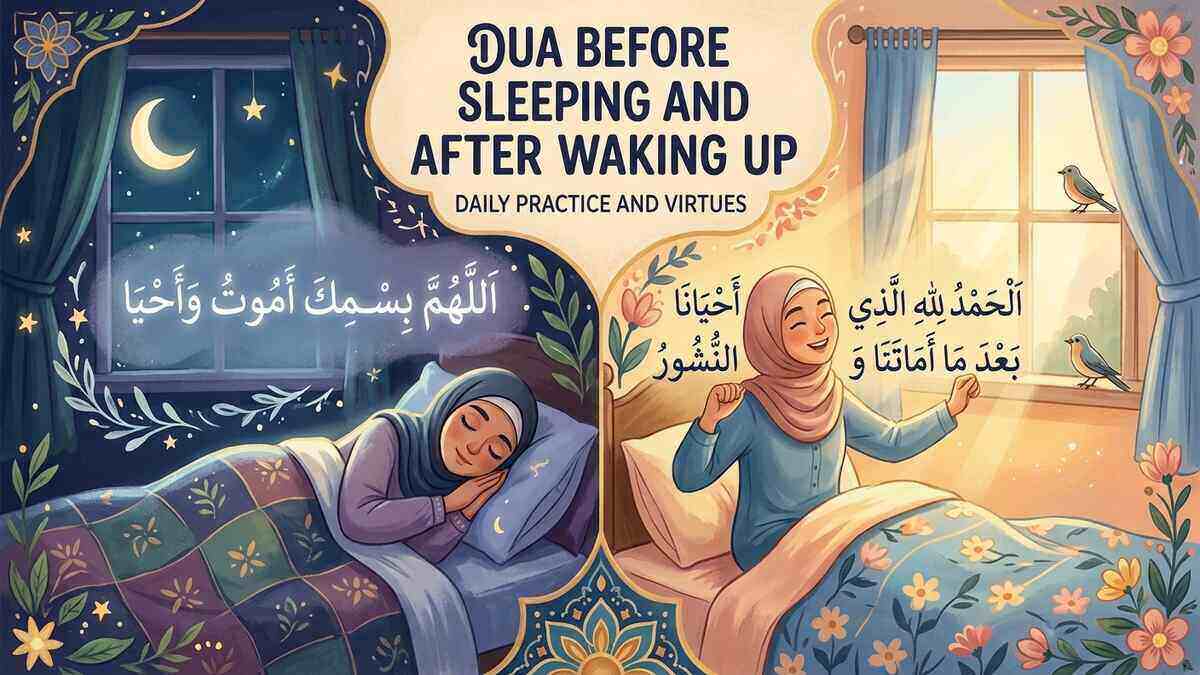
Most of us end the day scrolling and start it scrolling, and the hours between pass without a word to Allah. The Prophet ﷺ gave Muslims a better bookend for the day. This guide shares the dua before sleeping and after waking up, with the Arabic, the transliteration, the meaning and the source, plus a simple routine that fits a busy life in the USA, Canada or the UK at Deen Truth Hub.
What Is the Dua Before Sleeping and After Waking Up?
The dua before sleeping is “Bismika Allahumma amutu wa ahya” (In Your name, O Allah, I die and I live). The dua after waking up is “Alhamdu lillahil-ladhi ahyana ba’da ma amatana wa ilayhin-nushur” (All praise is for Allah who gave us life after causing us to die, and to Him is the resurrection). Both are reported in Sahih al-Bukhari.
Sleep is described as a small death, which is why the two duas mirror each other. One hands your soul to Allah at night. The other thanks Him for returning it.
Dua Before Sleeping: What to Say at Night
1. The core dua before sleep
Arabic: بِاسْمِكَ اللَّهُمَّ أَمُوتُ وَأَحْيَا
Transliteration: Bismika Allahumma amutu wa ahya.
Meaning: “In Your name, O Allah, I die and I live.”
Hudhayfah (RA) reported that the Prophet ﷺ said this when he went to bed (Sahih al-Bukhari). It takes three seconds, so there’s no excuse to skip it.
2. Ayat al-Kursi
Abu Hurayrah (RA) reported that whoever recites Ayat al-Kursi (Surah al-Baqarah, 2:255) when going to bed will have a guardian from Allah, and Shaytan won’t come near him until morning (Sahih al-Bukhari). Read it from the Qur’an if you haven’t memorized it yet.
3. The three Quls
Aisha (RA) reported that each night the Prophet ﷺ cupped his hands, blew into them, recited Surah al-Ikhlas, al-Falaq and an-Nas, then wiped over his body as far as he could reach, three times (Sahih al-Bukhari). If you’ve been feeling unwell, you might also read our guide to Ayat e Shifa dua for health.
4. The dua with your hand under your cheek
Arabic: اللَّهُمَّ قِنِي عَذَابَكَ يَوْمَ تَبْعَثُ عِبَادَكَ
Transliteration: Allahumma qini ‘adhabaka yawma tab’athu ‘ibadak.
Meaning: “O Allah, protect me from Your punishment on the day You resurrect Your servants.”
The Prophet ﷺ used to place his right hand under his cheek and say this, as reported in Sunan Abi Dawud and Jami at-Tirmidhi.
More Sunnah steps at bedtime
- Make wudu as for prayer, then lie on your right side (Sahih al-Bukhari).
- Recite the last two verses of Surah al-Baqarah. The Prophet ﷺ said they suffice a person who recites them at night (Sahih al-Bukhari and Sahih Muslim).
- Say 33 SubhanAllah, 33 Alhamdulillah and 34 Allahu Akbar. The Prophet ﷺ taught this to Fatimah (RA) as better than a servant (Sahih al-Bukhari and Sahih Muslim).
You don’t need all of these on day one. Start with the first dua and add one more each week.
Dua After Waking Up: What to Say in the Morning
Arabic: الْحَمْدُ لِلَّهِ الَّذِي أَحْيَانَا بَعْدَ مَا أَمَاتَنَا وَإِلَيْهِ النُّشُورُ
Transliteration: Alhamdu lillahil-ladhi ahyana ba’da ma amatana wa ilayhin-nushur.
Meaning: “All praise is for Allah, who gave us life after having caused us to die, and to Him is the resurrection.” (Sahih al-Bukhari)
Say it before you reach for your phone. If you wake at night, you can add the Prophet ﷺ’s practice of wiping the sleep from your face and reciting the last ten verses of Surah Ali Imran (3:190-200), reported in Sahih al-Bukhari and Sahih Muslim. For a longer morning routine, see our guide to the dua when waking up.
A Simple Routine for Busy Muslims in the USA, Canada and the UK
Life in the West doesn’t always bend around the Sunnah. Late shifts, long commutes and shifting clocks make routines hard.
- Clock changes. When daylight saving time shifts in the spring and fall, your bedtime and Fajr move too. Keep the dua tied to going to bed, not to a clock time.
- Short winter nights, long summer ones. In the UK and northern Canada, Fajr can be before 4 a.m. in summer. Sleep early where you can, and keep the morning dua short.
- Phones and screens. Charge your phone across the room, so your first words in the morning are the dua, not a notification.
- Shift workers. The duas apply whenever you sleep and wake, whether that’s midnight or noon.
- Families. Teach children one line at bedtime. A short habit sticks better than a long lecture.
A realistic version: put the phone down, make wudu, say the bedtime dua and read Ayat al-Kursi. It takes about three minutes. Read more
Common Mistakes With the Dua Before Sleeping and After Waking Up
- Scrolling until you fall asleep. The best intention fades after an hour of screens.
- Treating the duas as lucky charms. They’re remembrance and a request for protection, and they work alongside responsibility and prayer.
- Skipping them when tired. That’s exactly when a short dua helps most.
- Giving up after a missed night. Pick it up the next evening. Consistency beats perfection.
- Adding too much too soon. Start small, or the routine won’t last the week.
Here’s the encouraging part. Plenty of people find they sleep more calmly once the day ends with remembrance instead of news and notifications. Here’s the discouraging part. It takes a few weeks to feel automatic, and the first days can feel awkward. That’s normal.
Frequently Asked Questions
What is the dua before sleeping?
It’s “Bismika Allahumma amutu wa ahya,” meaning “In Your name, O Allah, I die and I live.” It’s reported in Sahih al-Bukhari.
What is the dua after waking up?
It’s “Alhamdu lillahil-ladhi ahyana ba’da ma amatana wa ilayhin-nushur,” reported in Sahih al-Bukhari. It means praise is for Allah who gave us life after death, and to Him is the return.
Should I sleep on my right side?
Yes. The Prophet ﷺ advised making wudu and lying on the right side when going to bed (Sahih al-Bukhari).
Can I say the duas in English?
Saying the Arabic is best, and you can add your own words in any language. Learn the Arabic over time, and keep your own words as a bridge.
Conclusion: Start Tonight
Tonight, put your phone away, make wudu and say “Bismika Allahumma amutu wa ahya.” Tomorrow morning, say the waking dua before you move. If this guide helped, share it with a family member, and explore more practical Islamic guides at Deen Truth Hub. Tell us in the comments which dua you’re starting with.
A note on accuracy: this article reflects mainstream Sunni sources. For personal religious questions, speak with a qualified local scholar.

2 thoughts on “Did You Recite These Duas Today? Dua Before Sleeping and After Waking Up”