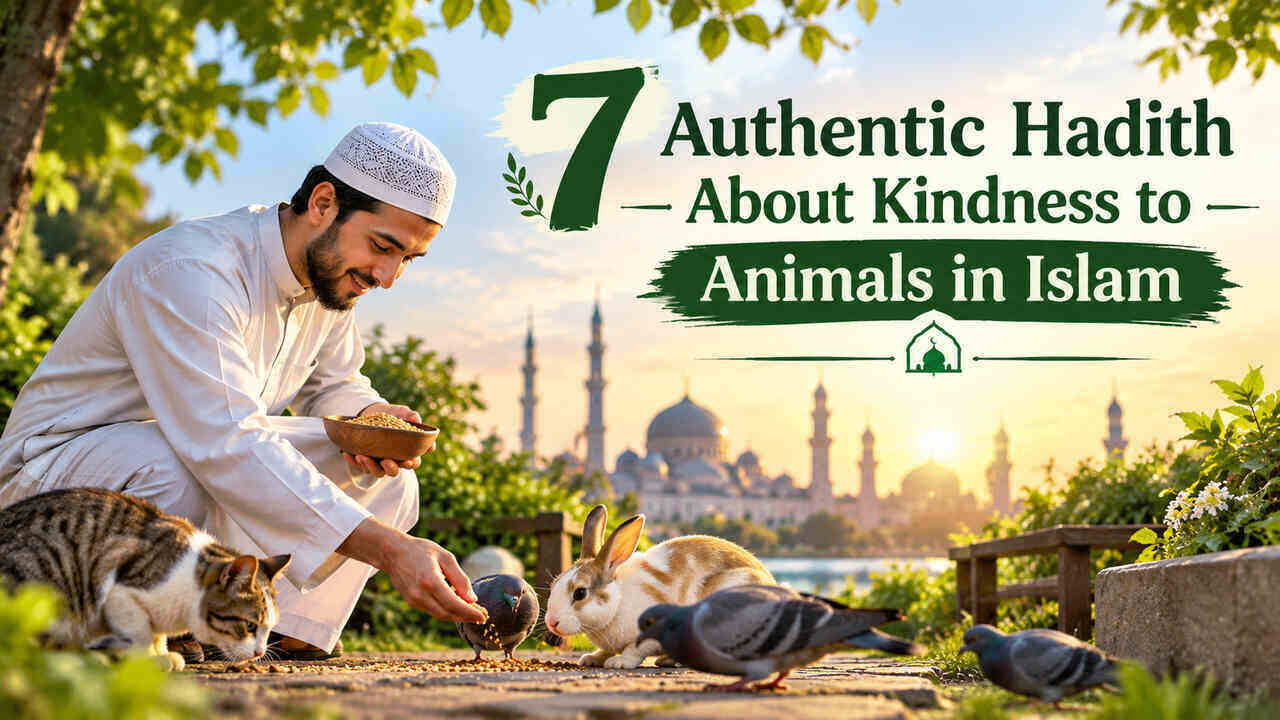
Here, we will learn hadith about kindness to animals in Islam. A stray cat waits outside your building every evening. A bird hits the window. A neighbor’s dog sits in the cold with no water. What does Islam ask of you in moments like these? The Prophet ﷺ answered more directly than most people expect. This guide shares seven authentic hadith about kindness to animals, with sources and plain, practical lessons for everyday life at Deen Truth Hub.
What Does Islam Say About Kindness to Animals?
Islam teaches that kindness to animals is an act of worship that Allah rewards, and cruelty to them is a sin that can be punished. The Prophet ﷺ said that there is a reward for kindness to every living creature (Sahih al-Bukhari and Sahih Muslim).
That’s the principle behind every hadith below. Animals are Allah’s creation, and we’re answerable for how we treat the ones in our care and the ones we simply meet.
7 Authentic Hadith About Kindness to Animals
1. A man forgiven for giving water to a dog
Abu Hurayrah (RA) reported that the Prophet ﷺ said a man was walking when he became very thirsty. He found a well, climbed down, drank and came out. There he saw a dog panting and eating mud from thirst. He thought, “This dog is as thirsty as I was,” so he went back down, filled his shoe with water, held it in his mouth as he climbed, and gave the dog a drink. Allah thanked him and forgave him. The Companions asked, “Is there a reward for us in animals?” He answered, “In every living creature there is a reward” (Sahih al-Bukhari and Sahih Muslim).
One shoe of water, and a sin wiped clean. It’s a staggering example of how small a good deed can be. Read more…
2. A woman punished for a cat
The Prophet ﷺ said a woman entered the Fire because of a cat she had tied up. She neither fed it nor let it go to eat from the earth (Sahih al-Bukhari and Sahih Muslim).
Here’s the sobering side. One act of neglect toward a helpless animal carried a punishment this severe. Cruelty doesn’t need to be violent to count. Neglect is enough.
3. Excellence, even at the time of slaughter
Shaddad ibn Aws (RA) reported that the Prophet ﷺ said: “Allah has prescribed excellence in everything. So when you kill, kill well, and when you slaughter, slaughter well. Let one of you sharpen his blade and give the animal comfort” (Sahih Muslim).
If excellence is required even at the moment of slaughter, it’s required in how we feed, house and handle animals every day.
4. Never use a living animal as a target
Ibn Umar (RA) reported that the Prophet ﷺ cursed whoever takes a living creature as a target (Sahih al-Bukhari and Sahih Muslim). Using animals for cruel sport or target practice is clearly forbidden.
5. The bird’s young and the burned ants
Abdullah ibn Mas’ud (RA) reported that a bird was circling above the Prophet ﷺ and his companions, distressed because someone had taken its chicks. He asked, “Who has distressed this bird by taking its young? Return them to her.” He also saw an anthill that had been burned and said, “It’s not right for anyone to punish with fire except the Lord of the fire” (Sunan Abi Dawud).
A mother bird’s distress mattered to him. If you’ve ever moved a nest or trapped an animal, this hadith is a real reminder. Read more….
6. The camel that complained
Abdullah ibn Ja’far (RA) reported that the Prophet ﷺ entered an orchard and found a camel that began crying and its eyes filled with tears. He wiped behind its ears until it calmed. Then he asked, “Who owns this camel?” A young man from the Ansar came forward. The Prophet ﷺ said, “Don’t you fear Allah regarding this animal that Allah has given you? It complains to me that you starve it and overwork it” (Sunan Abi Dawud).
This hadith is about ownership as a trust. Whoever has an animal in their care is responsible for its food, rest and wellbeing.
7. Fear Allah regarding animals that cannot speak
Sahl ibn al-Handhaliyyah (RA) reported that the Prophet ﷺ passed a camel whose back had become thin from hunger and said, “Fear Allah regarding these animals that cannot speak. Ride them while they’re in good condition, and eat them while they’re in good condition” (Sunan Abi Dawud).
Animals can’t tell us when they’re suffering. The hadith asks us to notice for them.
Practical Ways to Follow These Hadith in the USA, Canada and the UK
You don’t need a farm. Everyday life in North America and Britain gives plenty of chances.
| Situation | What the Sunnah suggests |
|---|---|
| A hot summer day | Never leave a pet or any animal in a parked car. Heat can kill within minutes |
| Freezing winter | Bring pets inside, and put out water and shelter for strays where it’s safe |
| Feeding birds | Put out seed and unfrozen water in winter |
| A stray in need | Offer food and water, or contact a local shelter or rescue |
| Adopting a pet | Treat it as a commitment to food, vet care and attention for its whole life |
| Buying meat | Choose suppliers who follow good welfare standards, where you can |
| Wildlife or insects | Avoid cruelty. Remove them humanely if necessary |
Scholars differ about keeping dogs as household pets, but they agree that mercy toward dogs and every other animal is required. Adopting a pet is also a promise to care for it, which connects to what we covered in our guide to the hadith about keeping promises.
The Good and the Bad of Our Treatment of Animals
The encouraging side is how little it takes. A bowl of water, a safe spot in winter or a call to a local rescue can count as a deed that earns forgiveness, as the man with the dog discovered.
The discouraging side is how easily we look away. Neglect, careless pet ownership, cruel sport and thoughtless handling are all things the Prophet ﷺ warned against. If you’ve ever felt unsure whether you should have helped an animal, these hadith are your answer.
Common Mistakes
- Treating animal welfare as optional. The hadith link it directly to reward and punishment.
- Assuming only pets matter. Strays and wildlife are included in “every living creature.”
- Adopting without planning. An animal depends on you for life.
- Confusing mercy with neglect. Letting an animal suffer because “it’s just an animal” is exactly what the hadith criticize.
- Forgetting humane treatment at slaughter. A sharp knife and calm handling are part of the Sunnah.
Frequently Asked Questions About Hadith About Kindness to Animals
What is the most famous hadith about kindness to animals?
It’s the hadith of the man who gave water to a thirsty dog and was forgiven, ending with “In every living creature there is a reward” (Sahih al-Bukhari and Sahih Muslim).
Is it a sin to be cruel to animals in Islam?
Yes. The Prophet ﷺ described a woman entering the Fire because of a cat she confined and starved (Sahih al-Bukhari and Sahih Muslim), and he cursed those who use living animals as targets.
Can I keep pets in Islam?
Scholars allow keeping many animals such as cats and birds, and differ on dogs, with some permitting them for guarding, hunting or herding. Everyone agrees that animals must be treated with mercy.
Does kindness to animals include strays?
Yes. The hadith of the thirsty dog involved a stray, and the reward was for “every living creature.”
Conclusion: Do One Kind Thing This Week
Choose one small step: leave water out for a stray, check on a neighbor’s animal or volunteer an hour at a local shelter. If this guide helped, share it with a friend, and explore more practical Islamic guides at Deen Truth Hub. Tell us in the comments how you’ve shown mercy to an animal.
A note on accuracy: this article reflects mainstream Sunni sources. For personal religious or legal questions, speak with a qualified scholar.
