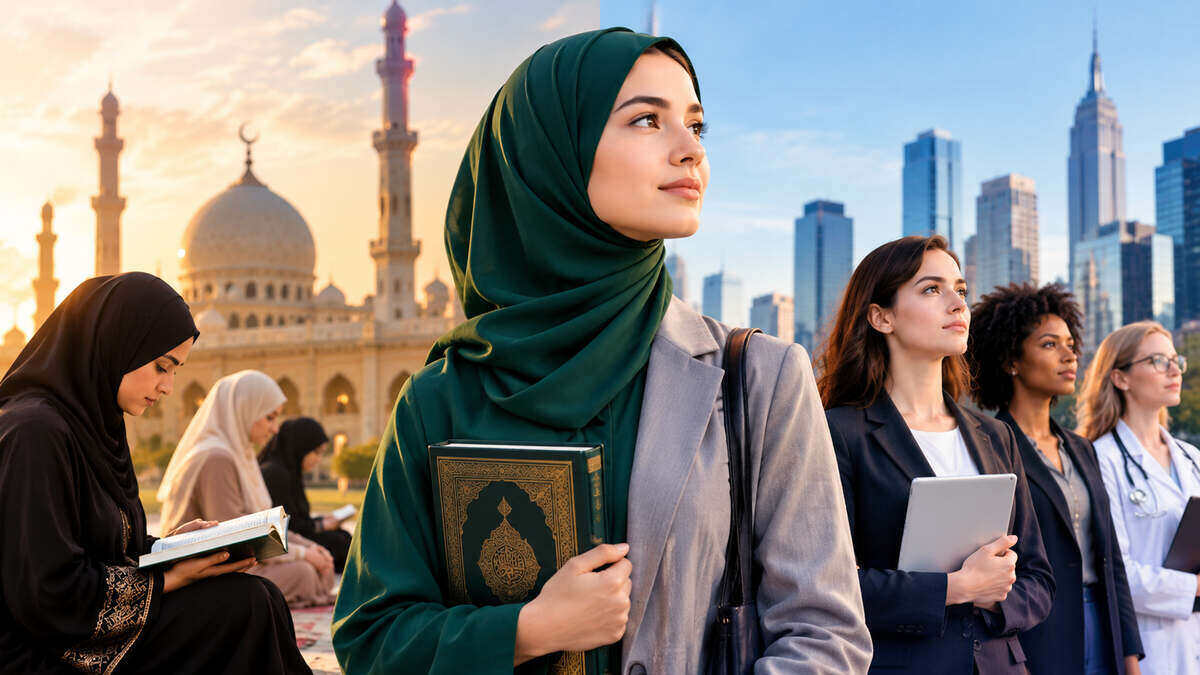
Ask ten people about women’s rights in Islam vs West and you’ll get ten loud, confident answers. Most of them are built on headlines, not facts. The real picture is more interesting, and a lot less one-sided. Below, you’ll see how both systems treat property, education, marriage, work and personal choice, where each one is strong, and where each one falls short.
What Does “Women’s Rights in Islam vs West” Actually Mean?
Short answer: The comparison sets a religious legal tradition (Islam, drawn from the Quran, the Prophet’s example and centuries of scholarship) against a group of secular legal systems (the “West,” meaning mainly Europe and North America) that grew out of political reform movements.
That difference matters. Islam is a faith with texts. The West is a set of countries with constitutions that change through votes and court cases. So you’re not comparing like with like, and anyone who treats them as two identical teams is skipping a step.
There’s a second trap. What a text says and what a government does are different things. Some Muslim-majority countries follow classical rights closely. Others ignore them or twist them. The same goes for Western countries and their own ideals of equality.
When you read any claim on this topic, ask two questions. Is this about the teaching, or about practice in one particular country? And what year are we talking about?
This blog discusses about, Women’s Rights in Islam vs West, Women’s Rights in Islam vs West: The Ultimate Showdown, Empowerment or Illusion? Women’s Rights in Islam vs The West, Women’s Rights in Islam vs West: A Definitive Comparison, The Real Comparison of Women’s Rights in Islam vs West, Women’s Rights in Islam vs West — Which is Truly Better? ,The Hidden Reality of Women’s Rights: Islam vs The West, Women’s Rights in Islam vs West, Women’s Rights in Islam vs West, Women’s Rights: Islam vs West.
How Did Each Side Begin? A Short History
Islam in the 7th century
When Islam arrived in Arabia in the 600s, it gave women legal standing that many societies around the world didn’t offer for a long time afterward. Women could own and manage their own wealth. They were entitled to a share of inheritance (Quran 4:7 and 4:11–12). A bride received a marriage gift, the mahr, which belonged to her alone (Quran 4:4). Marriage required her consent.
The Prophet’s first wife, Khadija bint Khuwaylid, ran a successful trading business and employed the man she later married. Muslims point to her as proof that working, earning women were part of the faith from day one.
The West before reform
In England and in the early United States, the doctrine of coverture meant a married woman’s property and legal identity folded into her husband’s. England only began to loosen this with the Married Women’s Property Acts of 1870 and 1882. American states moved piece by piece through the mid-1800s.
Voting came even later. New Zealand granted women the vote in 1893. The US followed in 1920. The UK gave women equal voting terms in 1928, France in 1944, and Switzerland didn’t allow women to vote in federal elections until 1971. In the US, a woman could be refused a credit card without a male co-signer until the Equal Credit Opportunity Act of 1974.
So the timeline is messier than either camp likes to admit. The West wrote formal legal equality into law later than many people assume.
How Do Property, Inheritance and Money Compare?
Here’s where the sharpest disagreements show up. A quick side-by-side:
| Issue | Islamic legal tradition | Modern Western law |
|---|---|---|
| Owning property | Women keep full control of their own wealth, before and after marriage | Equal ownership rights; spouses often share marital property |
| Inheritance | Fixed shares; a daughter often receives half of a son’s share, but mothers, wives and sisters also have defined shares | Generally equal between sons and daughters, subject to the will |
| Marriage payment | Husband owes the wife mahr, which is hers | No equivalent; prenuptial agreements are optional |
| Financial support | Husband must maintain his wife, even if she is wealthy | Support depends on divorce settlements and local law |
| Earnings | Wife’s income is hers; she has no duty to spend it on the household | Spouses commonly pool income, though not required |
Look at the inheritance row closely, because it’s the one critics raise first. The classical reasoning is that a son inherits more but carries the duty to financially support his wife, children and often his parents. A daughter inherits less but has no obligation to support anyone, and her money stays her own.
Does that logic hold in a modern household where women earn, and men sometimes don’t? Plenty of Muslim scholars and legal reformers say it needs rethinking. Tunisia’s leaders have debated equal inheritance. Others defend the fixed shares as divinely set. This is a live argument inside the Muslim world, not just a Western complaint.
On the other side, Western women gain from straightforward equal treatment in law. But they’ve also been left without anything like mahr or a guaranteed maintenance right, which Muslim women’s advocates often point out.
What About Education, Work and Public Life?
Education
Islamic tradition treats seeking knowledge as a duty for both men and women. Fatima al-Fihri is traditionally credited with founding the University of al-Qarawiyyin in Fez in 859, often described as one of the oldest continuously operating universities in the world. Women scholars of hadith were common in early Islamic history.
Compare that with the 19th-century West, where universities across Europe and America shut women out for decades.
Today the picture flips in places. Western countries offer near-universal girls’ education. Meanwhile, the Taliban in Afghanistan have barred girls from secondary school and university since 2021, a policy that most Islamic scholars and Muslim-majority governments have openly rejected as contrary to Islam. The cruel irony: a government claiming religious authority is contradicting the faith’s own history of female scholarship.
Work and leadership
Modern Western law bans discrimination in hiring and pay. Even so, gaps persist. Pew Research Center’s 2023 analysis found US women earned about 82 percent of what men earned per hour in 2022.
Muslim-majority countries, meanwhile, have elected women to the very top. Benazir Bhutto in Pakistan, Tansu Çiller in Turkey, Megawati Sukarnoputri in Indonesia, and both Khaleda Zia and Sheikh Hasina in Bangladesh led their countries. Bangladesh was led by a woman prime minister for most of the years between 1991 and 2024. The United States, as of this writing, has never had a woman president.
Yet that same region shows some of the lowest rates of women’s labour-force participation, driven by custom, safety concerns and legal restrictions that vary widely by country. Both facts are true at once.
How Do Marriage, Divorce and Family Law Differ?
In Islamic law, marriage is a contract, not a sacrament. The wife can write conditions into it. She can seek divorce through khul’, usually by returning her mahr, and many modern legal codes also let her go to court.
A husband holds the right of talaq, and polygamy (up to four wives, with a demand for strict fairness in Quran 4:3) is allowed in principle. Many countries have narrowed this. Tunisia banned polygamy in 1956. Turkey prohibits it. In Bangladesh, a man needs written permission from an Arbitration Council before taking a second wife under the Muslim Family Laws Ordinance of 1961.
Western family law gives both spouses equal access to divorce, mostly no-fault, with courts dividing property and deciding custody. That’s simpler and more symmetrical. It also leaves many women, particularly mothers who stayed home, financially exposed after a split.
Violence is the uncomfortable common ground. The World Health Organization estimates that around one in three women worldwide experiences physical or sexual violence in her lifetime. No region, religion or political system escapes that number.
What About Hijab, Modesty and Personal Choice?
This is the most visible part of the debate, and the most emotional.
Islamic teaching asks both men and women to dress modestly, and most scholars read that as including a head covering for women. The Quran also states there is no compulsion in religion (2:256). That principle is exactly why forced veiling, as in Iran’s compulsory hijab laws, draws criticism from many Muslims themselves.
The West isn’t consistent either. France banned conspicuous religious symbols in public schools in 2004 and face coverings in public in 2010. A woman who wears hijab by choice can end up policed by the state, which looks a lot like the compulsion Western critics condemn elsewhere.
Here’s a fair test: does the woman choose? If she does, the garment is a personal decision. If a state or a family forces it, or forces her to remove it, her rights have been violated. That standard applies in Tehran and in Paris alike.
Women’s Rights in Islam vs West: Which Is Better?
Direct answer: Neither system wins across the board. Islam, as taught in its classical sources, gives women strong financial protections (own property, mahr, maintenance) from the start. Western law gives women stronger formal equality in inheritance, divorce and public life. The biggest factor is enforcement, not ideology.
Let me be blunt about where I land. Judging by texts alone, you can build a strong case for either side, and people do. Judging by real lives, the answer depends on which country, which family and which decade you pick. A woman in Dhaka, Dearborn, Oslo and Kabul will describe four very different realities, and religion doesn’t explain every difference.
A few honest points:
- Islam’s strength: guaranteed financial independence and protection, an emphasis on women’s education and consent in marriage.
- Islam’s weakness in practice: local custom and patriarchal readings that override the texts, and laws in some countries that give men unequal power in divorce and custody.
- Western strength: equal rights written into constitutions, strong anti-discrimination courts, wide access to education and work.
- Western weakness in practice: the pay gap, sexual harassment, domestic violence, and a culture that sometimes reduces women to their appearance.
If you want the one-line verdict, it’s this: the better system is the one that gets enforced fairly, and that has to be judged country by country.
How Can You Judge Any Claim About This Topic?
You’ve probably seen viral posts that make one side look perfect and the other look monstrous. Before you share one, run a quick check.
- Find the source. Is it the Quran, a hadith, a national law, or someone’s opinion?
- Check the country and year. Saudi Arabia let women drive in 2018. Laws move.
- Separate teaching from practice. A scholar’s reading isn’t the same as a government’s policy.
- Look for women’s own voices. Muslim women and Western women both speak for themselves. Read them first.
- Watch for cherry-picking. The worst example from one side is always compared with the best example from the other.
Frequently Asked Questions
Does Islam give women equal rights?
Islam grants women equal spiritual accountability, property rights, education and consent in marriage. Some legal rules, such as inheritance shares and divorce procedures, differ between men and women, and Muslims debate how to interpret them today.
Are women treated better in the West than in Muslim countries?
It depends on the measure and the country. Western nations generally have stronger legal equality and fewer formal restrictions. Many Muslim-majority countries have elected women leaders and protect women’s wealth, but others restrict women’s work, dress or movement.
Why do daughters inherit less than sons in Islam?
Classical law gives sons larger shares because they carry the duty of financially supporting family members, while a daughter’s inheritance stays entirely her own. Some modern reformers and scholars argue this should change where women are the main earners.
Does the Quran allow forced hijab?
The Quran states there is no compulsion in religion (2:256), and many Muslim scholars use this verse to argue against forced veiling. Laws that mandate hijab, as in Iran, are political decisions and not a universally accepted Islamic ruling.
Which country is best for women?
No single country is best on every measure. Rankings such as the World Economic Forum’s Global Gender Gap Report compare countries on health, education, economic and political participation, and Nordic countries top them most years. Rankings can’t capture a woman’s daily experience, so use them as a starting point only.
Final Verdict: Look at Facts, Not Slogans
The truth about women’s rights in Islam vs West isn’t a scandal, and it isn’t a victory lap for either side. Islam gave women property and legal standing early, and the West built strong equality laws later. Both have gaps between what they promise and what they deliver.
Want to go deeper? Read primary sources, study the actual laws of one specific country, and listen to women who live under each system. Then tell us what surprised you in the comments, and share this guide with someone who needs the full picture instead of the headline.
