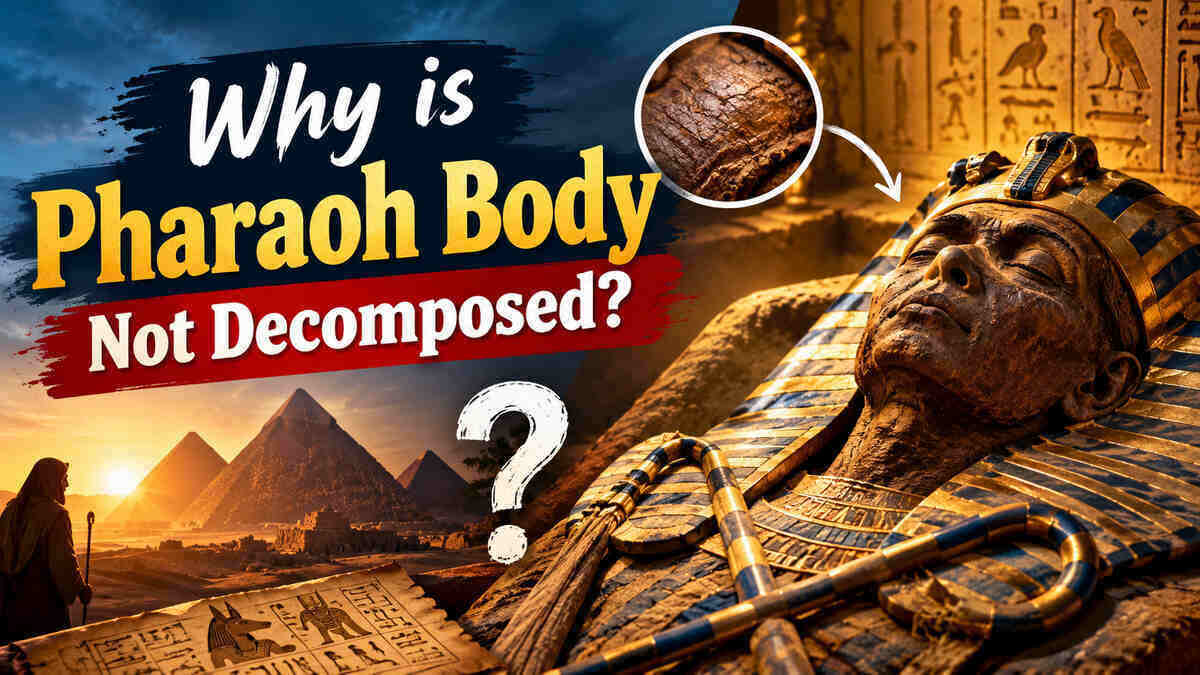
A drowning king begs for mercy at the last second, and Allah answers with a strange promise: his body will survive as a sign. That’s the pharaoh body in Quran miracle, and it’s one of the most shared stories in Islamic discussion online. This guide walks through the verse, the mummy evidence, and the parts that are solid versus the parts that are still debated, so you can speak about it with confidence and accuracy.
What Does the Quran Say About Pharaoh’s Body?
The Quran says Allah would save Pharaoh’s body after he drowned, so that it would be a sign for those who came after him. The key verse is Surah Yunus, 10:92.
فَالْيَوْمَ نُنَجِّيكَ بِبَدَنِكَ لِتَكُونَ لِمَنْ خَلْفَكَ آيَةً ۚ وَإِنَّ كَثِيرًا مِّنَ النَّاسِ عَنْ آيَاتِنَا لَغَافِلُونَ
Fal-yawma nunajjika bi-badanika li-takuna liman khalfaka ayah. Wa inna kathiran minan-nasi an ayatina la-ghafilun.
Meaning: “So today We will save you in body that you may be to those who succeed you a sign. And indeed, many among the people, of Our signs, are heedless.” (Quran 10:92, Sahih International)
The verses before it set the scene. The Children of Israel crossed the sea. Pharaoh and his army chased them out of “tyranny and enmity.” As the water closed over him, he suddenly said he believed in the God of Israel. The next verse (10:91) replies: “Now? And you had disobeyed before and were of the corrupters.”
Notice the wording. The verse says “in body” (bi-badanika). It doesn’t mention embalming, a museum, or Egypt. That detail matters, and we’ll come back to it.
This blog discusses about, pharaoh body in quran miracle in English, pharaoh body in quran miracle in Hindi explain, pharaoh body in quran miracle full history. Is it true? pharaoh body in quran , miraclepharaoh body in quran miracle,pharaoh body in quran miracle in islam.
The Story Behind the Verse: Musa, Pharaoh and the Sea
Before looking at mummies, it helps to know what the verse is actually about. The Quran tells the story of Prophet Musa (Moses) and Pharaoh in many places. Pharaoh claimed to be a god. He oppressed the Children of Israel. Musa came with clear signs, and Pharaoh kept refusing.
Then came the escape. Allah parted the sea, Musa’s people crossed, and Pharaoh’s army followed and drowned.
Why Did Allah Reject Pharaoh’s Last-Second Faith?
The Prophet ﷺ is reported to have said that Allah accepts repentance until the soul reaches the throat (Tirmidhi). Pharaoh’s belief came at the moment he saw death, when it was no longer a choice made in freedom. That’s the lesson: don’t postpone turning back to Allah.
What Was the “Sign” Meant to Be?
At the level of the verse, the sign is a warning. A man who said “I am your lord most high” ended as a lifeless body that people could see and recognize as just a body.
Classical commentators, including Ibn Kathir, mention reports that the corpse was cast onto the shore so that people could see Pharaoh was dead and not a god. Some Israelites apparently couldn’t believe he had really drowned. That reading doesn’t depend on any modern discovery at all. It’s the primary meaning many scholars have taken for centuries.
How Does the Mummy Connect to the Pharaoh Body in Quran Miracle?
The modern argument runs like this: the Quran said the body would be saved as a sign, and today we can view royal mummies of ancient Egyptian kings in a museum in Cairo. So the verse points to a body that survived into the modern age.
Here’s the part of the story most people repeat.
The 1976 Paris Examination
In 1976, Egypt sent the mummy of Ramesses II to France for treatment because it was deteriorating from fungus. Reports describe it being received with full honors, and a widely repeated detail says its passport listed the occupation as “King (deceased).” French doctor Maurice Bucaille took part in examining the body.
Bucaille was a surgeon who later wrote The Bible, The Qur’an and Science (1976), where he connected Quran 10:92 to the preservation of a pharaoh’s body. His book became hugely popular in Muslim communities, and it’s where much of the “miracle” narrative originates.
Bucaille’s argument, in short: the Quran predicted a body would be saved, and ancient Egyptian royal bodies still exist and can be seen.
Which Pharaoh Was It?
This is where honest writing has to slow down. Muslim scholars and historians don’t agree on which pharaoh the Quran refers to, because the Quran doesn’t name him. It uses the title “Pharaoh” (Fir’awn).
| Candidate | Why people suggest him | The difficulty |
|---|---|---|
| Ramesses II | Famous, long reign, mummy examined in Paris | No historical record places him at a drowning |
| Merneptah (his son) | Often suggested because the Merneptah Stele (c. 1208 BCE) names “Israel” | Studies of his mummy show an old man with arthritis and heart disease, with no sign of drowning |
| Other kings | Other dynasties have been proposed | Dating the Exodus is still unresolved |
Merneptah’s mummy was found in 1898 by Victor Loret in a cache of royal mummies in tomb KV35. It was unwrapped in Cairo in 1907, and in 2021 it was moved to the National Museum of Egyptian Civilization. Ramesses II’s mummy is part of the same royal collection.
So who is the “pharaoh body” in Quran miracle? Nobody can say for certain, and that includes both believers and skeptics.
What Is Well Established, and What Isn’t?
Let’s separate the claims. This is the section that will build trust with readers, because many viral posts blur these lines.
Well Established
- Quran 10:92 says Pharaoh’s body would be saved as a sign for later generations.
- Royal mummies of ancient Egyptian pharaohs survive and are displayed in Cairo.
- Ramesses II’s mummy was examined and treated in Paris in 1976, and Bucaille was involved.
- Bucaille published his reading of 10:92 in a widely read book.
Disputed or Unproven
- That Ramesses II was the Pharaoh of the Exodus. Historians and Egyptologists don’t accept this as established, and most don’t treat the Exodus as a dated event in Egyptian records at all.
- That any mummy shows signs of drowning. Online posts often claim scientists found salt or sea damage proving the king drowned. I couldn’t find reliable scientific support for that. Treat it as unverified unless a source is given.
- That Bucaille “converted to Islam” because of the mummy. This is a popular story, but you should be careful repeating it as fact without a solid source.
If you share this topic, stick to the first list. It’s accurate, and it can’t be knocked down by a skeptic with a quick search.
Why Do Skeptics Say It Isn’t a Miracle?
You’ll meet these objections in comments sections, and they deserve fair answers.
“Egyptians mummified their kings anyway.”
That’s true. Preserving royal bodies was standard Egyptian practice for thousands of years. So the existence of a mummy alone doesn’t prove anything. A critic can say the verse just describes something that would have happened anyway.
A Muslim reply: the verse doesn’t just say “a body will exist.” It links the body to a drowned king who claimed divinity, and it says the body will be a sign. Many Muslims find it notable that Egypt’s royal dead were, in fact, rediscovered after thousands of years and put on public view, in a culture that once hid them in sealed tombs. But yes, this is an argument from fit, not a laboratory proof, and it’s best presented that way.
“Maybe badanika means something else.”
Some scholars have read bi-badanika as “with your body” and others as “with your armor,” since the word badan has been used in classical Arabic with both senses. The mainstream reading, “in your body,” is the one most translators use. It’s worth knowing the language point exists so you aren’t caught off guard.
“No mummy has been shown to belong to the Exodus Pharaoh.”
Correct. No museum label says “Pharaoh of the Exodus.” That’s why the careful claim is “a pharaoh’s body can be seen today,” not “we have identified the exact man.”
Why Does the Miracle of Pharaoh Body in Quran Still Get So Much Attention?
There are a few reasons, and they say something about how people think.
First, it’s visual. Most signs in the Quran are ideas. This one you can picture: a king, a sea, a body, a glass case. A story with an image travels fast.
Second, it speaks to a modern worry. Many young Muslims want to know whether the Quran can stand next to history and science without embarrassment. The miracle of pharaoh body in Quran is often the first example they hear, so it carries a lot of weight in their minds.
Third, it’s easy to turn into a short video, and short videos tend to flatten nuance. That’s how “a pharaoh’s body survives” quietly became “scientists proved he drowned.” If you’ve seen the second version online, now you know where the gap is.
The healthier approach is to treat the topic like a good teacher would. Start with the verse. Add the history you can check. Say plainly what remains open. Readers, including non-Muslims and doubters, tend to trust a writer who admits limits far more than one who oversells.
What Should You Take Away From This Miracle?
Whether or not you see the mummy as a proof, the verse’s message is clear and practical.
- Power doesn’t last. Pharaoh controlled an empire, and the Quran shows him as a helpless body.
- Repentance has a window. Turn back while it’s still your choice.
- Heedlessness is common. The verse ends with “many among the people are heedless of Our signs.” The real danger isn’t missing a museum exhibit. It’s walking past the signs in your own life.
- Faith doesn’t depend on a headline. The Quran stands on its own message. A mummy can be an interesting reminder, but it isn’t what holds up your belief.
For students of knowledge and anyone writing or teaching about this: present Bucaille’s argument as an argument, state what’s confirmed, and flag what’s open. People respect that, and it protects you from easy rebuttals.
Frequently Asked Questions
Which verse mentions the pharaoh’s body in the Quran?
Surah Yunus, verse 92 (10:92). It says Allah would save Pharaoh “in body” so that he would be a sign to those who came after him.
Which pharaoh is the one mentioned in the Quran?
The Quran doesn’t name him, only the title “Pharaoh.” Ramesses II and his son Merneptah are the most commonly suggested, but historians haven’t confirmed any identification, and Muslim scholars hold different views.
Is the pharaoh’s body really preserved today?
Royal mummies of many Egyptian pharaohs are preserved and displayed in Cairo, including Ramesses II and Merneptah. Whether one of them is the pharaoh of the Quran’s story can’t be proven.
Did Maurice Bucaille examine the mummy of Ramesses II?
Yes. He took part in the examination when the mummy was in Paris in 1976, and he later wrote about 10:92 in The Bible, The Qur’an and Science. His conclusions are respected by many Muslims and criticized by others.
Is the pharaoh body in Quran miracle proven by science?
Science confirms that royal mummies exist and can be studied. It doesn’t confirm which king the Quran refers to, or that any mummy shows drowning. The miracle is best understood as a sign and warning, supported by an argument from fit, not as a scientific proof.
Read the Verse Yourself
Open Surah Yunus and read verses 90 to 92 slowly, in a translation you trust. Then ask what it says about your own life, because that’s the sign the verse is really pointing at.
If this guide cleared things up, share it with a friend who’s been confused by viral posts about the pharaoh’s body. Accurate sharing is a form of care for the truth.
Note: This article offers general information and doesn’t replace consultation with a qualified scholar. Historical identifications mentioned here are debated among historians and Muslim scholars.
Sources: Maurice Bucaille (Wikipedia) · Merneptah (Wikipedia) · KV35 (Wikipedia)
