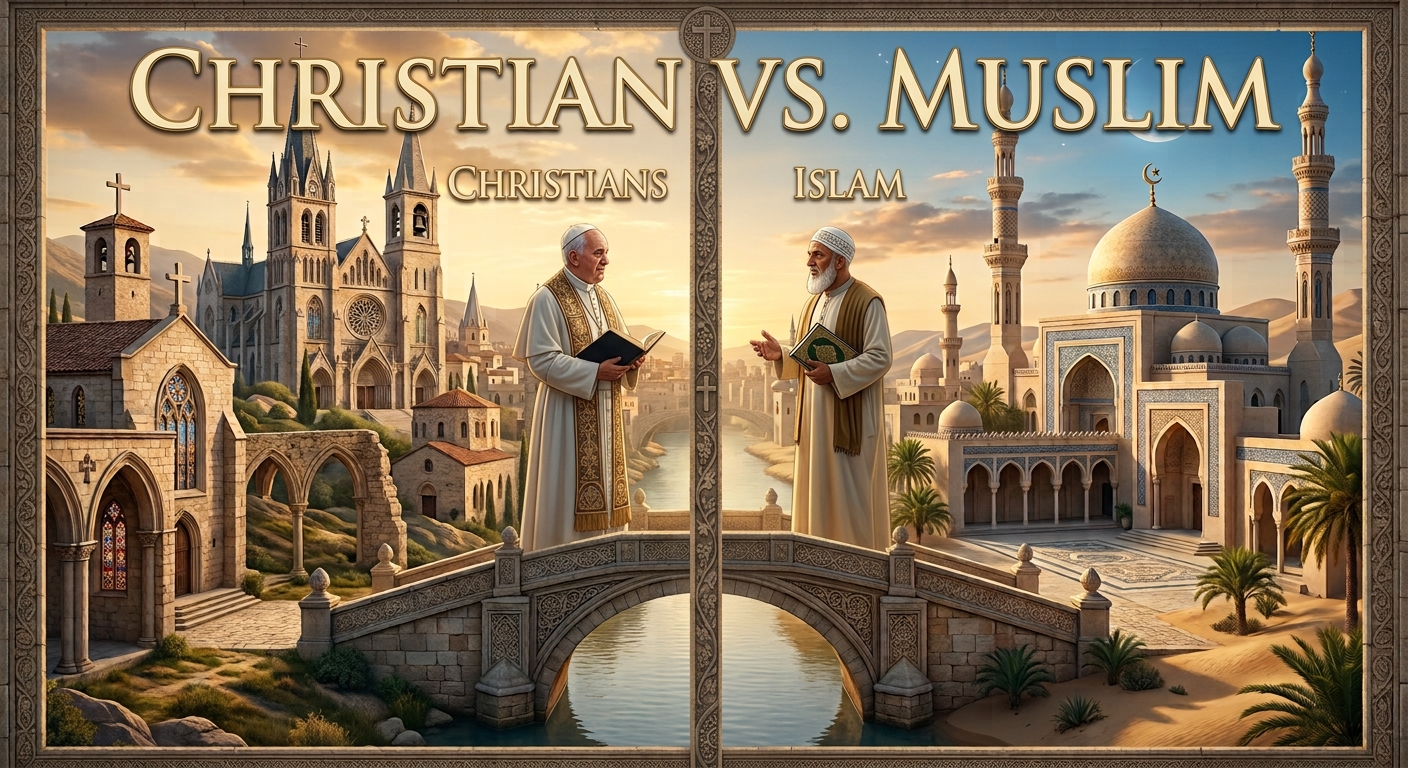
You’ve probably heard it said that Christians and Muslims “believe in the same thing”, or the exact opposite. Neither is quite right. The two faiths share a lot of ground, and they also disagree on some very big questions. This guide to Christian vs Islam: 4 differences takes you through the main ones in plain language, describing each faith the way its own followers describe it.
Christian vs Islam: The 4 key Differences at a Glance
The four biggest differences between Christianity and Islam are how each understands God, who Jesus is, which scripture is the final revelation, and how a person is saved from sin.
Muslims believe in one indivisible God and see Jesus as a prophet. Christians believe in one God in three persons and see Jesus as the divine Son of God. Those two points shape almost everything else.
What Do Christians and Muslims Have in Common?
Before the differences, it’s worth seeing the common ground. Both faiths trace themselves to Abraham, and together they’re followed by billions of people. Pew Research estimated that in 2020 there were about 2.3 billion Christians and roughly 2 billion Muslims worldwide.
They also share a surprising amount:
- Belief in one God who created everything
- Belief in prophets, including Abraham, Moses, and Jesus
- Belief in angels, a Day of Judgment, Heaven, and Hell
- The virgin birth of Jesus through Mary (Maryam)
- Emphasis on prayer, charity, and moral living
Mary, for example, has an entire chapter in the Quran named after her (Surah Maryam, 19). So when people compare Christian vs Islam, it’s not a story of two strangers. It’s closer to two relatives who disagree about important family matters.
Difference 1: The Nature of God
This is the foundation. Everything else flows from it.
The Islamic View: Tawhid
Muslims believe in absolute oneness of God, called tawhid. God isn’t divided into parts, has no partner, and has no son. Surah al-Ikhlas (112) is a short summary of this belief. The Quran also directly addresses the Christian idea of three, telling the People of the Scripture to stop saying “three” and affirming that God is one (4:171).
The Christian View: The Trinity
Christians also believe in one God. But they understand God as one being in three persons: the Father, the Son, and the Holy Spirit. All three are seen as eternal and sharing the same divine nature. Christians don’t think of this as three gods. They see it as a mystery about the single God’s inner life, and it’s central to Christian identity.
So the question in Christian vs Islam isn’t “one God or many?” Both say one. The question is whether God’s oneness includes this threefold nature.
Difference 2: Who Is Jesus?
This might be the difference people hear about most, and it’s also where the two faiths overlap the most.
What Muslims Believe About Jesus
In Islam, Jesus (Isa) is one of the greatest messengers of God, born miraculously to the virgin Mary. The Quran calls him the Messiah and says he performed miracles by Allah’s permission. But Muslims believe he’s a human prophet, not God or God’s son (4:171).
On the crucifixion, the Quran says Jesus was not killed or crucified, but that it was made to appear so to others (4:157). Muslims believe he was raised up by Allah and will return before the end of time.
What Christians Believe About Jesus
For Christians, Jesus is God the Son, the second person of the Trinity, fully divine and fully human. They believe he was crucified, died for humanity’s sins, and rose again on the third day. His death and resurrection are the center of the Christian faith.
A Quick Point of Overlap
Both believe in the virgin birth. Both honor Jesus as a miracle worker. And both traditions teach that he’ll return. They differ on who he is and what he did.
Difference 3: Scripture and Final Revelation
Islam: The Quran
Muslims believe the Quran is the word of Allah, revealed to Prophet Muhammad ﷺ over about 23 years, and preserved in its original Arabic (15:9). It’s seen as the final revelation, confirming earlier scriptures and correcting changes made to them. Muslims also honor the Torah and the Gospel (Injil) as originally revealed, while believing the text people hold today differs from what was first given.
Christianity: The Bible
Christians hold the Bible as sacred scripture. It includes the Old Testament and the New Testament, written by many human authors over centuries and understood to be inspired by God. Protestant Bibles have 66 books, while Catholic Bibles include a few more. Christians generally don’t believe a later prophet came after Jesus to bring a final revelation.
That’s also why the status of Muhammad ﷺ differs. Muslims see him as the final prophet. Christianity doesn’t recognize him as a prophet.
Difference 4: Sin and Salvation
The Christian Teaching
Many Christian traditions teach that humanity inherited a sinful condition from Adam, often called original sin, and that people can’t earn their way out of it. Salvation comes by God’s grace through faith in Jesus, whose sacrifice is believed to atone for sin. Passages such as John 3:16 and Ephesians 2:8-9 are often cited.
The Islamic Teaching
Islam teaches that every child is born in a natural, pure state (fitra), without inherited sin. The Quran says no one bears another’s burden (6:164). Salvation depends on sincere faith, good deeds, and ultimately Allah’s mercy. Anyone can turn to God directly in repentance, without an intermediary, and the Quran tells believers not to despair of His mercy (39:53).
So where Christianity places the weight on what Christ did for humanity, Islam places the weight on faith, responsibility, and direct repentance to God.
Christian vs Islam: Side-by-Side Comparison
| Topic | Islam | Christianity |
|---|---|---|
| God | One, indivisible (tawhid) | One God in three persons (Trinity) |
| Jesus | Prophet and Messiah, not divine | Son of God, fully divine and human |
| Crucifixion | Denied (4:157) | Central event of faith |
| Scripture | Quran as the final revelation | Bible, Old and New Testaments |
| Final prophet | Muhammad ﷺ | Jesus is the center; no later prophet |
| Sin and salvation | Born pure; faith, deeds, and mercy | Original sin; saved by grace through Christ |
How to Talk About These Differences Respectfully
If you’re in a conversation with a friend or neighbor from the other faith, a few habits go a long way. This is especially relevant in places like Bangladesh, where Muslims and a small Christian community live side by side.
- Describe their beliefs the way they would. Don’t summarize them in your own words and then argue against that version.
- Start with what you share. Faith in one God, Mary, and care for the poor are good openings.
- Ask questions before making claims. You’ll learn more and the other person will feel heard.
- Stick to sources. For Muslims, the Quran and authentic hadith. For Christians, the Bible and their church’s teaching.
Frequently Asked Questions
Do Christians and Muslims worship the same God?
Both claim to worship the God of Abraham, the creator of the universe. They understand God’s nature differently, especially on the Trinity, so thinkers in both faiths disagree on how to answer this. It’s best to ask the person you’re talking to.
Is Jesus mentioned in the Quran?
Yes. Jesus (Isa) is mentioned many times in the Quran, and Mary has her own chapter (Surah Maryam, 19). The Quran describes him as a messenger and Messiah, but not as God or God’s son (4:171).
Do Muslims believe in the Bible?
Muslims believe in the Torah and Gospel as originally revealed by God. They don’t believe the text people hold today is exactly what was first given, so they treat the Quran as the final authority.
Which religion has more followers?
Christianity has more followers, with about 2.3 billion people compared with roughly 2 billion Muslims, according to Pew Research’s 2020 figures.
Will Jesus return?
Both traditions teach he will return before the end of time, but they describe his role differently. Muslims believe he returns as a prophet of Islam, while Christians believe he returns as Lord and Judge.
Final Thoughts
So, what are the real differences in Christian vs Islam: 4 differences, in short? How each faith understands God, who Jesus is, which scripture is final, and how salvation works. The two share real common ground, and understanding both clearly makes for kinder, better conversations.
Don’t stop at a summary. Open the Quran, read Surah Maryam (19), and see how it describes Jesus and his mother in its own words. Then explore more Quran- and hadith-based guides on deentruthhub.com, and share this article with someone who’s curious about how the two faiths compare.
Allah knows best.
Sources Checked
- Quran 4:171, on Jesus and the Trinity: alquran.cloud, 4:171
- Quran 4:157, on the crucifixion: alquran.cloud, 4:157
- Christian doctrine of the Trinity: Wikipedia, Trinity
- Population figures (2020), about 2.3 billion Christians and roughly 2 billion Muslims: National Catholic Register on Pew’s 2010-2020 report
Editor’s note before publishing: The sources above were checked online. Everything else was cited from memory and needs review: Quran 112, 19, 15:9, 6:164, 39:53; the fitra teaching (Sahih al-Bukhari and Sahih Muslim); the Bible book counts; and John 3:16 and Ephesians 2:8-9. Also have a knowledgeable Christian reader confirm the Christian sections describe their beliefs fairly. The Pew figure for Muslims is quoted as “roughly 2 billion” because the secondary source rounded it, so check Pew’s own report for the exact number.

2 thoughts on “Christian vs Islam: 4 key Differences Between Christian & Islam”